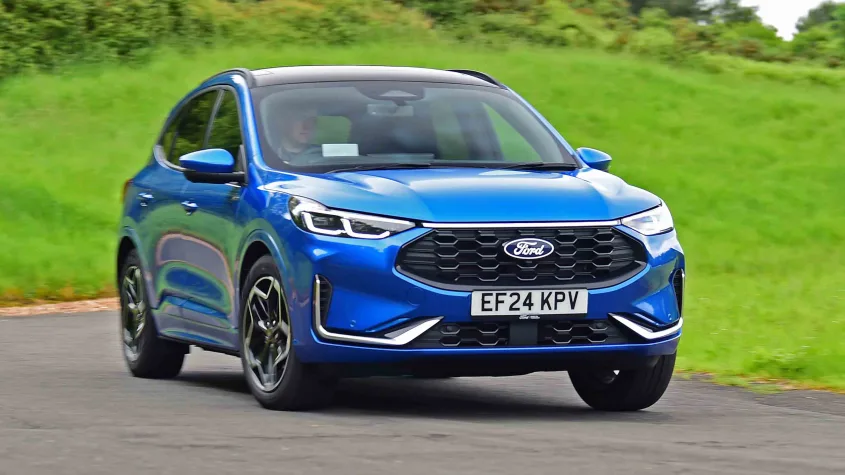
For decades, the idea of taking your hands off the steering wheel while cruising down the motorway belonged firmly in the realm of science fiction. Now, it’s edging closer to everyday reality. Ford has confirmed that its popular mid-size SUV, the Kuga, will be offered with the company’s latest driver-assistance technology: BlueCruise.
The system allows drivers to remove their hands from the wheel on certain roads while the car takes care of steering, acceleration and braking. It’s not fully autonomous driving, but it’s one of the most advanced systems currently approved for use on British roads.
And in a car as widely used as the Kuga, it could represent a major shift in how motorists experience long motorway journeys.
A New Kuga Built for Hands-Free Motorway Driving
Ford is introducing the technology through a new Kuga BlueCruise Edition, a special version designed to showcase the system. Prices start from around £41,995, positioning it towards the higher end of the Kuga line-up. Buyers can choose between a conventional full-hybrid setup or the more powerful plug-in hybrid model.
The hybrid variant delivers roughly 178bhp in front-wheel-drive form, rising slightly in the all-wheel-drive version, while offering fuel economy of around 50mpg in typical driving.
If performance and electric running appeal more, the plug-in hybrid option pushes output to around 240bhp and can travel over 40 miles on electric power alone before the petrol engine needs to step in.
In other words, the Kuga BlueCruise Edition isn’t just about technology – it still delivers the practicality and efficiency that made the SUV popular in the first place.
What Exactly Is BlueCruise?
BlueCruise is Ford’s most advanced driver-assistance system currently available in Europe. At its core, it combines adaptive cruise control with lane-centring technology, allowing the vehicle to handle steering and speed on suitable roads.
The real headline feature, however, is that it can do this without the driver holding the steering wheel. Instead, the system uses an interior camera to monitor the driver’s gaze and head position. As long as you remain attentive to the road, the car manages the driving inputs itself.
Think of it as “hands-off but eyes-on” driving. You’re still responsible for the car and must be ready to intervene, but the technology removes a large portion of the workload during long motorway slogs.
Where Can You Use It?
BlueCruise only works on specific pre-mapped sections of road known as “Blue Zones.” These are primarily motorways and major divided highways where conditions are predictable enough for the technology to operate safely.
In the UK alone, Ford says these zones cover around 95 per cent of the motorway network. Across Europe, the system currently supports approximately 84,000 miles of approved roads spanning 16 countries.
That means journeys along routes like the M25, M1 or M6 could potentially be completed with minimal driver input beyond supervision.
The Hardware Behind the Magic
To make this work, the Kuga relies on an intricate combination of sensors and software. Radar units and forward-facing cameras track traffic ahead, while lane-detection systems keep the vehicle centred between road markings.
Meanwhile, the driver-monitoring camera ensures the person behind the wheel is paying attention. If the system detects distraction or lack of focus, BlueCruise automatically disengages and prompts the driver to take back control.
It’s essentially a highly sophisticated evolution of adaptive cruise control rather than a truly self-driving system, falling into what the industry calls Level 2+ automation.
Special Edition Styling
Ford hasn’t limited the update to technology alone. The BlueCruise Edition also receives a few visual tweaks to set it apart from standard Kugas.
A distinctive Vapour Blue paint finish comes as standard, accompanied by black alloy wheels measuring 19 inches, with larger 20-inch options available. Inside, the cabin features part-leather seats with blue cloth inserts, subtly echoing the technology’s branding.
It’s not a dramatic redesign, but the touches give the SUV a slightly more premium feel.
Not Just the Kuga
The Kuga isn’t the only Ford gaining this technology. BlueCruise first appeared in the UK on the Mustang Mach-E electric SUV and is gradually spreading across the range.
New versions of the Ford Puma and other models are also expected to offer the system, signalling Ford’s intention to make advanced driver-assistance features more mainstream rather than reserving them for luxury vehicles.
What It Means for Everyday Driving
Motorway driving is often the most monotonous part of any journey: hours of steady speed, lane discipline and creeping traffic. Systems like BlueCruise aim to reduce fatigue by automating these repetitive tasks while still keeping the driver engaged.
For commuters who regularly tackle long distances, that could make a significant difference. Instead of constant steering corrections and throttle adjustments, the driver can simply supervise the journey while the car handles the routine work.
Of course, it’s not a licence to relax completely. The technology still expects full driver attention, and the legal responsibility remains firmly with the person behind the wheel.
The Future of Ford’s Driver Assistance
The arrival of BlueCruise in the Kuga shows how quickly advanced driver assistance is filtering into everyday family cars. What was once cutting-edge technology confined to expensive executive saloons is now appearing in mainstream SUVs.
As mapping improves and legislation evolves, systems like this will likely expand beyond motorways and gain new capabilities. For now, though, the Kuga’s BlueCruise Edition represents a glimpse of a future where long motorway drives require far less effort.
And while the steering wheel may not completely disappear anytime soon, the days of gripping it constantly on a three-hour motorway run may already be numbered.