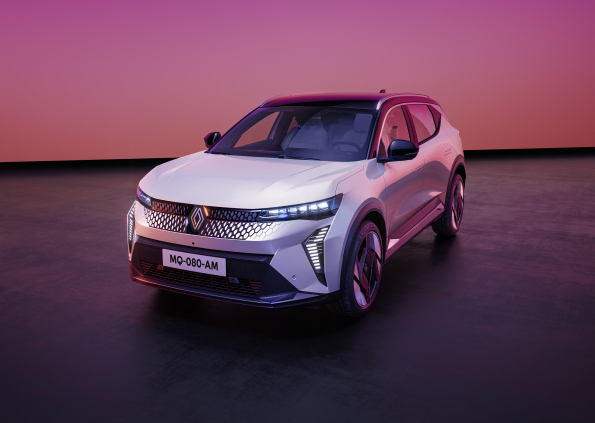
Renault is preparing a significant step forward in its electric vehicle strategy. The next generation of Megane and Scenic models is being engineered with technology designed to stretch driving range far beyond today’s standards, all while dramatically reducing charging time.
If the French brand delivers on its ambitions, future family EVs could soon travel more than 460 miles on a single charge and gain substantial range in roughly the time it takes to grab a coffee.
For drivers who still worry about range anxiety or long charging stops, Renault’s upcoming technology aims to tackle both problems head-on.
A new electric platform designed for bigger cars
At the heart of Renault’s upcoming EVs is a brand-new platform designed for the company’s mid-sized models. This architecture will underpin future versions of the Megane and Scenic, along with other vehicles positioned in the popular European C-segment. The platform has been developed to support several powertrain configurations, including:
- Fully electric drivetrains
- Range-extender hybrid systems
- Larger battery packs for long-distance capability
Renault’s focus is clear: produce EVs that appeal to mainstream buyers rather than niche early adopters.
Up to 466 miles of electric range
Perhaps the headline figure is the potential driving range of around 466 miles (approximately 750km) on a single charge. This would place Renault firmly among the longest-range electric cars in the mainstream market, exceeding the capabilities of many current EVs.
Today’s Megane E-Tech Electric typically offers around 280 miles of range depending on specification, powered by a 60kWh battery and a front-mounted electric motor producing roughly 217bhp. The latest Scenic E-Tech Electric, meanwhile, can achieve up to around 379 miles WLTP thanks to a larger battery pack and improved efficiency.
The next generation promises to move far beyond those figures thanks to:
- Higher-density battery chemistry
- Improved thermal management
- More efficient electric motors
- Advanced energy-management software
The result should be a family EV capable of tackling long motorway journeys without frequent charging stops.
10-minute charging: the next big EV breakthrough?
Range is only part of the story. Renault is also targeting extremely rapid charging times. Future Megane and Scenic models are expected to support technology capable of delivering a significant range boost in roughly ten minutes when connected to high-power charging infrastructure. To put that in context, many current electric vehicles require 30 to 40 minutes to reach an 80% charge on rapid chargers.
Cutting that wait down dramatically would transform the ownership experience, making EVs feel far closer to the convenience of petrol or diesel refuelling. The breakthrough will depend on a combination of factors:
- Next-generation battery cells
- Higher charging voltages
- Improved thermal management
- More powerful public charging networks
If Renault succeeds, it could set a new benchmark for practical long-distance EV travel.
Range-extender technology also under consideration
Interestingly, Renault isn’t putting all its eggs in the pure EV basket. The upcoming platform is also designed to support range-extender hybrid systems, where a small engine generates electricity to keep the battery topped up on longer journeys.
This approach could appeal to buyers who want the benefits of electric driving but still require absolute confidence when travelling long distances or in areas with limited charging infrastructure. Range-extender technology effectively bridges the gap between hybrid and fully electric vehicles.
Building on the success of Megane and Scenic
The Megane and Scenic nameplates carry significant history within Renault’s lineup.
- Megane has long been one of Renault’s core hatchback models, evolving from traditional combustion engines to today’s electric E-Tech version.
- Scenic, originally known as one of the pioneers of the compact MPV, has reinvented itself as a modern electric family SUV.
Both vehicles now sit on Renault’s AmpR Medium electric platform, which also underpins models across the Renault-Nissan-Mitsubishi alliance. The next iteration will push the boundaries even further, focusing on efficiency, practicality and everyday usability.
Renault’s broader EV strategy
These next-generation models form part of Renault’s broader push into electrification. The company has already launched or announced several key EVs, including:
- The retro-inspired Renault 5 E-Tech
- Electric crossovers like the Scenic
- Updated versions of established models such as the Megane
Combined with advanced battery technology and faster charging capabilities, Renault’s goal is clear: make electric cars more accessible, practical and desirable for mainstream buyers.
FAQs
When will the next-generation Renault Megane and Scenic arrive?
Renault has not confirmed an exact launch date, but both models are expected to appear later in the decade as part of the brand’s upcoming electrified vehicle strategy.
Will the new Megane and Scenic be fully electric?
Yes, fully electric versions are expected. However, the platform may also support range-extender hybrid systems depending on market demand.
What is the expected driving range?
Renault is targeting a maximum range of around 466 miles (750km) for future models using next-generation battery technology.
How fast will charging be?
Renault claims its upcoming EV technology could add substantial range in around 10 minutes when connected to high-power rapid chargers.
How does this compare with today’s Renault EVs?
Current models such as the Megane E-Tech offer around 280 miles of range, while the Scenic E-Tech can achieve roughly 379 miles depending on battery size.
Why is fast charging so important?
Reducing charging time is essential for widespread EV adoption. Ultra-rapid charging makes long journeys easier and helps electric cars feel closer to the convenience of traditional petrol vehicles.