Few things create more anxiety for drivers than seeing the engine management light suddenly illuminate the dashboard. Whether it appears during your daily commute, on a motorway journey, or just after starting the car, many motorists immediately assume the worst. However, while the warning light should never be ignored, it doesn’t necessarily mean your vehicle is about to suffer a catastrophic failure.
The reality is that the engine management light is simply your car’s way of telling you that something isn’t operating as expected. The challenge is that the warning light itself doesn’t reveal exactly what the problem is.
What is the engine management light?
Also known as the check engine light, the engine management light forms part of your vehicle’s onboard diagnostics system. Modern vehicles constantly monitor hundreds of sensors and components responsible for engine performance, emissions, fuel delivery, ignition timing, and more. When the system detects a fault or reading outside of expected parameters, it stores a diagnostic trouble code and illuminates the warning light on the dashboard.
This could indicate something relatively minor, such as a loose fuel cap, or something more serious involving the engine, transmission, emissions system, or electrical components.
Common reasons the engine management light appears
While every vehicle is different, several common faults frequently trigger the warning light.
Faulty oxygen sensor
The oxygen sensor helps regulate fuel mixture and emissions. If it begins to fail, your vehicle may experience reduced fuel economy, rough running, or increased emissions.
Ignition system problems
Worn spark plugs, faulty ignition coils, or other ignition-related issues can cause misfires, leading to poor performance and activation of the engine management light.
Emissions system faults
Modern vehicles utilise increasingly complex emissions control systems. Components such as EGR valves, catalytic converters, DPF systems, and AdBlue equipment can all generate warning lights when faults occur.
Sensor failures
Modern cars rely on numerous sensors to monitor airflow, fuel pressure, temperature, turbocharger performance, and countless other functions. Even a relatively inexpensive sensor can trigger a dashboard warning.
Battery and electrical issues
In some cases, low battery voltage or electrical faults can cause warning lights to appear, particularly on vehicles with sophisticated electronic systems.
Flashing vs constant warning lights
Not all engine management warnings carry the same level of urgency. A steady warning light often indicates a fault that should be investigated soon but may not require immediate action.
A flashing engine management light, however, typically suggests a more serious issue, often related to engine misfires that could potentially damage the catalytic converter or other components. If the light begins flashing, you should reduce speed and seek professional assistance as soon as possible.
Why guessing can become expensive
One of the biggest mistakes drivers make is attempting to diagnose the problem based solely on symptoms or online forums. For example:
- Poor acceleration could indicate anything from a faulty sensor to a turbocharger issue.
- Rough idling could stem from ignition components, fuel delivery problems, or air intake faults.
- Increased fuel consumption could involve multiple systems.
Without proper diagnostics, replacing parts based on guesswork can quickly become expensive.
The importance of reading fault codes
When the engine management light appears, the vehicle stores a fault code within its onboard computer system. This code provides a valuable starting point for identifying the underlying issue. Rather than relying on assumptions, reading the stored diagnostic codes can dramatically reduce the time and cost involved in troubleshooting.
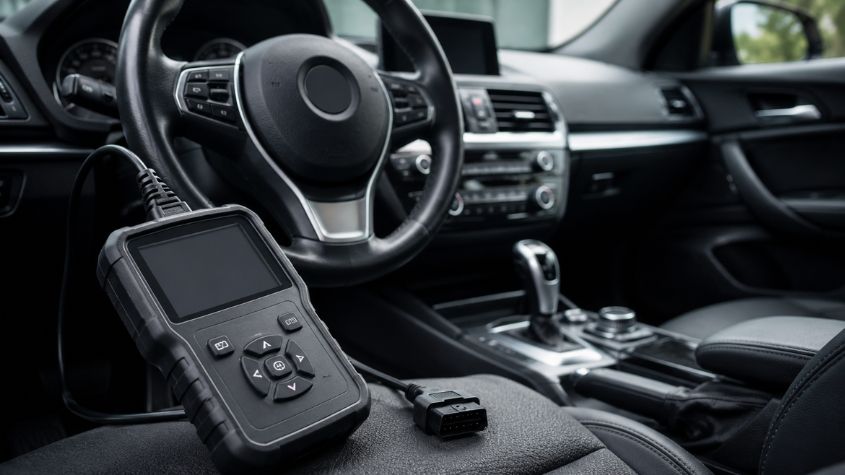
Many motorists now use OBD2 diagnostic scanners to access these codes themselves before visiting a garage. These devices connect directly to the vehicle’s diagnostic port and can reveal fault information, live sensor data, and system health information within minutes.
An OBD2 scanner can identify the exact fault code rather than relying on guesswork, helping drivers make more informed decisions about repairs and maintenance.
Should you continue driving?
In many cases, a vehicle with a steady engine management light will remain safe to drive for a short period. However, this depends entirely on the nature of the fault. If you notice any of the following symptoms, you should stop driving and seek assistance:
- Significant loss of power
- Excessive smoke from the exhaust
- Unusual engine noises
- Overheating
- A flashing engine management light
Ignoring these signs could result in further damage and significantly higher repair costs. The engine management light isn’t designed to frighten drivers; it’s designed to provide an early warning that something requires attention.
While the underlying cause can range from a minor sensor fault to a more significant mechanical issue, obtaining accurate diagnostic information is the most effective way to determine what your vehicle is really trying to tell you.
Rather than replacing parts unnecessarily or relying on online speculation, identifying the stored fault codes can provide a clearer picture of the problem and help you take the appropriate next steps.

Rob is an experienced automotive journalist and editor, with a passion for all things automotive. Whether it’s automotive news and reviews, the latest in EV technology, or just an unusual take on the latest models, Rob is all over it!