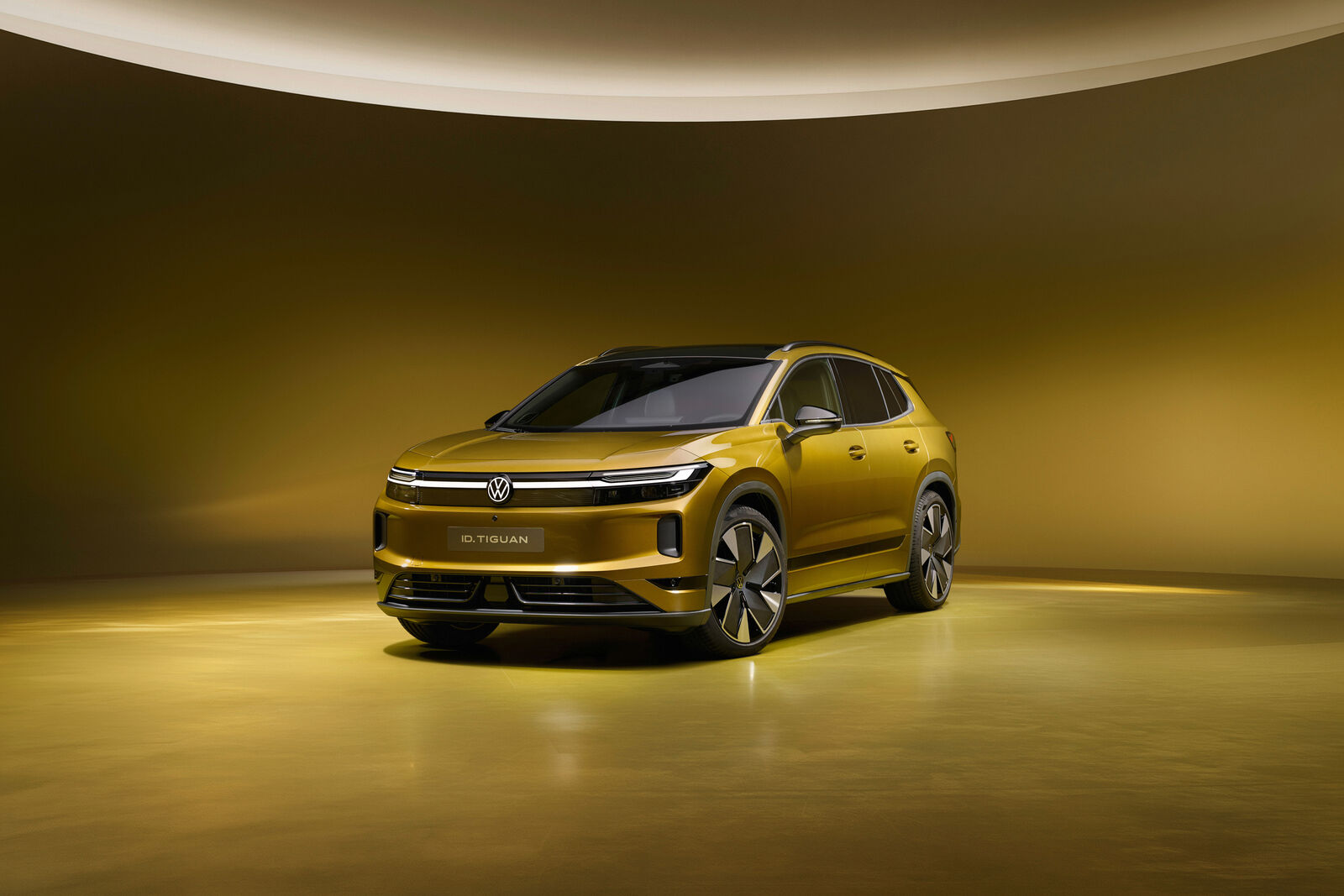
Volkswagen has finally admitted what plenty of car buyers worked out years ago: a familiar name is easier to remember than something that sounds like a hotel room number. The new ID. Tiguan will replace both the ID.4 and ID.5 from early 2027, and it already feels more like a Volkswagen before anyone has turned a wheel.
This is a fully electric SUV rather than a battery-powered version of the existing Tiguan. The petrol, diesel and plug-in hybrid Tiguan stays on sale alongside it, so showroom conversations may require careful punctuation. Even so, borrowing the badge of Volkswagen’s worldwide bestseller is a confident move. The company is done asking ordinary buyers to learn a second alphabet simply because there is a battery under the floor.
The ID.4 replacement has found its identity
The ID. Tiguan is built on Volkswagen’s MEB+ electric platform and comes in three flavours. The entry model has rear-wheel drive, 190PS and a 58kWh battery. A 286PS rear-driver and a 299PS 4MOTION version use a 77kWh battery. Volkswagen says the longest-legged combination will manage up to 600 kilometres on the WLTP test, which is roughly 373 miles.
Those are competitive numbers, but the more interesting detail is the character Volkswagen is trying to recover. The ID.4 was perfectly easy to understand as a product yet strangely hard to care about. It had the emotional pull of a replacement router. The ID. Tiguan wears a squarer, more upright body, conventional pull-type door handles and a face that looks related to the latest combustion-engined Tiguan without copying it panel for panel.
That is the correct sort of conservatism. A family SUV does not need to resemble a spacecraft that has swallowed a boiled sweet. It needs to look reassuring in a supermarket car park, survive the school run and still seem worth the monthly payment three winters later.
Physical buttons make a welcome return
Volkswagen’s early ID cabins often confused minimalism with hiding useful controls. The ID. Tiguan appears to have received the memo. Climate basics now sit on a button bar in the centre console, the steering wheel has physical buttons and a rotary controller handles volume and track changes. None of this is revolutionary. That is precisely why it is good news.
The screens have multiplied rather than disappeared. There is a 10-inch driver display and a 15-inch central touchscreen, while a 12-inch passenger display will be available. Its privacy filter prevents the driver from watching whatever the passenger is doing, and Bluetooth headphones keep the soundtrack private. Whether anyone needs three displays in a Tiguan is debatable, but at least the heater no longer has to audition for a supporting role in a touchscreen maze.
There is also a pleasing streak of silliness. A Retro display can dress the instruments like those in a fourth-generation Golf, replacing the rev counter with an energy-flow gauge. The main screen can show a virtual garage containing old Volkswagens including the original Golf, Beetle and first-generation Tiguan. Nostalgia built into software is still nostalgia, and it gives this cabin more warmth than acres of generic ambient lighting.
Useful numbers matter more than digital theatre
The practical case looks convincing. Volkswagen quotes 534 litres of boot space plus a 32-litre front compartment. The smaller battery can tow up to 1,800kg, while the 77kWh versions stretch that to two tonnes. Vehicle-to-load support can power external electrical equipment through an adaptor plugged into the charging port. That could mean an e-bike, a tool or, if the marketing photos have their way, an improbably serene electric barbecue.
One-pedal driving is standard, and the options list includes massaging and ventilated front seats, a 480-watt Harman Kardon stereo and a panoramic roof. Connected Travel Assist can support lane changes on motorways and respond to red traffic lights where the system and local conditions allow. Buyers will be offered Trend, Life, Style and R-Line trims.
German pre-sales begin on 13 October at €42,695, though Volkswagen has not announced UK prices in its launch material. That missing figure will decide whether the ID. Tiguan becomes the obvious electric family Volkswagen or merely the one with the obvious name.
A badge change with a point
Renaming an electric SUV is hardly an engineering breakthrough, but Volkswagen’s decision says something useful. Electric cars no longer need to behave like a separate species. Drivers understand Polo, Golf and Tiguan; attaching ID. to those names explains the powertrain without throwing away decades of recognition.
The ID. Tiguan still has to prove its efficiency, charging performance and road manners when production cars arrive. On paper, however, it combines a credible range, proper towing ability and a cabin that has rediscovered buttons. The smartest feature may be the simplest one: Volkswagen has made its electric SUV sound like a car people already know.
Sources
- Auto Express: Volkswagen ID. Tiguan revealed
- Volkswagen Newsroom: ID. Tiguan world premiere
- Volkswagen Newsroom: ID. Tiguan image DB2026AU00895
Image credit: Volkswagen AG

We are experienced automotive journalists and editors, with a passion for all things automotive. Whether it’s automotive news and reviews, the latest in EV technology, or just an unusual take on the latest models, we’re all over it!