Let’s start with an uncomfortable truth. Some of the fastest cars on the road are surprisingly boring.
There. I said it.
Modern electric vehicles can launch from 0-60mph with the sort of brutality that would have embarrassed a supercar just fifteen years ago. Yet many of them feel about as dramatic as using an efficient hand dryer at an airport. You press the accelerator, the horizon comes towards you at alarming speed, and somehow your brain remains completely unimpressed.
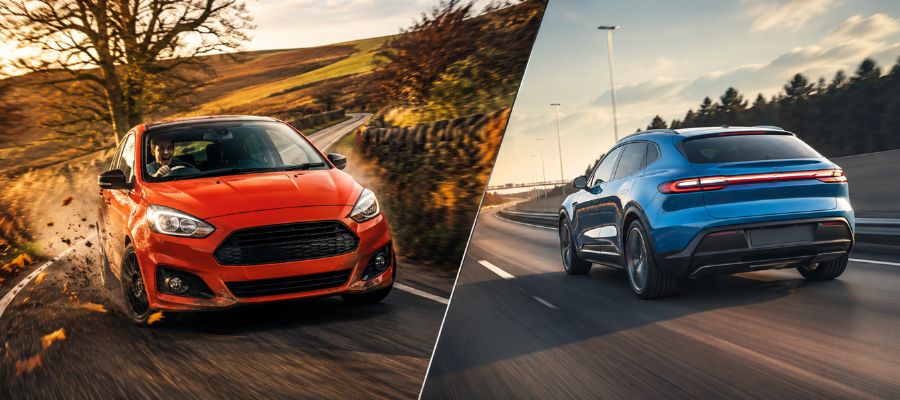
Meanwhile, a tiny hot hatch from twenty years ago with half the power can make you feel like you’re auditioning for the next Fast & Furious film.
So what gives? Why do certain cars feel ridiculously fast, even when the numbers suggest otherwise? The answer lies somewhere between engineering, psychology, noise, vibration, and humanity’s strange addiction to drama.
The Clarkson Principle: Noise Equals Speed
For decades, motoring enthusiasts have been conditioned to believe that noise equals performance. It’s why a V8 muscle car rumbling at idle feels dangerous even when it’s sitting completely still. It’s why guitar solos make action scenes better. It’s why nobody remembers the quiet bits in a Michael Bay film.
Your brain associates sound with excitement.
A naturally aspirated sports car screaming towards its redline creates anticipation. The engine note rises. The vibrations increase. The mechanical chaos builds. Your senses are telling you something extraordinary is happening.
An electric car producing almost no noise can accelerate considerably faster, but because the soundtrack is missing, your brain doesn’t receive the same emotional cues. It’s the automotive equivalent of watching a horror film with the volume muted. Technically, everything is still happening. It just doesn’t feel as intense.
Small Cars Feel Faster Than Big Cars
Ever noticed how a small hatchback can feel quicker than a luxury SUV with significantly more horsepower? That’s because size matters. Not in the way car salesmen on YouTube thumbnails would have you believe. When you’re sitting low to the ground, close to the road, every speed feels amplified. The world rushes past your side windows. Road markings blur. The sensation of movement becomes exaggerated. It’s why a lightweight sports car travelling at 40mph can feel more exciting than a large SUV travelling at 70mph.
The lower driving position tricks your senses into thinking you’re moving faster. It’s exactly the same reason fighter jet sequences in films like Top Gun feel exhilarating. The camera sits close to the action, making speed appear more dramatic. Height creates comfort. Low seating creates excitement.
Manual Gearboxes Create The Illusion Of Performance
Here’s another controversial opinion: manual gearboxes make average cars feel heroic.
Modern automatics are objectively better. They’re quicker. They’re smoother. They’re more efficient. But they’re often less entertaining. Changing gears yourself creates involvement. Every acceleration run becomes an event. Every successful downshift feels like you’ve personally contributed to the car’s performance.
In reality, you may be slower than a modern automatic gearbox. But it doesn’t matter. Your brain isn’t measuring lap times. It’s measuring engagement. This is why people still fondly remember old hot hatches that would struggle to keep up with many modern family cars. The experience was richer. The driver felt important.
The Fastest Cars Are Sometimes Too Good
This might sound ridiculous, but some modern performance cars have become victims of their own excellence. Manufacturers have spent decades eliminating noise, vibration, harshness, body roll, and mechanical imperfections.
The result? Cars that can reach extraordinary speeds while feeling completely composed. The problem is that humans often interpret comfort as slowness. A luxury performance saloon travelling at motorway speeds can feel almost stationary because the cabin remains calm and isolated. Meanwhile, an older performance car might be rattling, vibrating, shouting through the exhaust, and making you question your life choices.
Guess which one feels faster? Exactly. The one threatening your hearing.
Steering Feel Is More Important Than Horsepower
Here’s a statistic nobody puts on a dealership poster. Many drivers can’t accurately estimate horsepower. What they can detect immediately is steering feel. A car with sharp steering responses feels alive. The front end reacts instantly. Every movement seems urgent. Even modest power outputs suddenly feel exciting.
This is why some lightweight sports cars develop cult followings despite having relatively humble performance figures. They’re responsive. They’re eager. They feel like they’re reading your mind. The automotive world often obsesses over horsepower figures because they’re easy to market. But steering feel creates emotional connection. And emotional connection creates perceived speed.
The Need For Drama
Humans are storytellers. We’ve always been storytellers. We don’t remember the technically perfect performance. We remember the dramatic one.
Nobody leaves the cinema talking about the scene where everything worked exactly as planned. They remember the explosions. The near misses. The chaos.
Cars are no different. A vehicle that squirms slightly under acceleration, growls through tunnels, and delivers a bit of theatre feels memorable. A technically superior machine that performs flawlessly but silently may be faster, yet often feels less special.
This explains why so many enthusiasts become emotionally attached to imperfect cars. Imperfection creates character. Character creates memories. Memories create legends.
Why Hot Hatches Get Away With Murder
Hot hatches might be the greatest offenders in automotive history. Many aren’t particularly fast by modern standards. Yet owners talk about them as if they’re driving Formula One cars.
Why?
Because hot hatches are masters of sensory deception. They’re compact. They’re noisy. They’re often fitted with firmer suspension. The driving position is lower. The steering feels sharper. Every sensation is exaggerated.
The result is a car that constantly convinces you something extraordinary is happening. Even if a stopwatch politely disagrees.
The EV Paradox
Electric vehicles have created one of the strangest situations in modern motoring. They’re often incredibly quick. Sometimes shockingly quick. Yet many drivers describe them as feeling less exciting than slower petrol cars.
This isn’t because they’re worse. It’s because they’re different. They remove many of the traditional signals our brains associate with speed. There’s no gear change drama. No rising engine note. No theatrical mechanical soundtrack. It’s like replacing a rock concert with noise-cancelling headphones. The performance is still there. The emotion is simply delivered differently.
So What Actually Makes A Car Feel Fast?
After all the science, psychology, and automotive nonsense, the answer is surprisingly simple.
Cars feel fast when they engage your senses.
Noise. Steering. Vibration. Driving position. Gear changes. Responsiveness. Drama.
These things matter far more than many enthusiasts would like to admit. A car doesn’t need 600 horsepower to feel exciting. It needs personality.
That’s why people still smile when talking about old sports cars, lightweight roadsters, and cheeky hot hatches.
The stopwatch might tell one story. Your heart tells another. And if automotive history has taught us anything, it’s that drivers rarely fall in love with numbers.
They fall in love with feelings.

Rob is an experienced automotive journalist and editor, with a passion for all things automotive. Whether it’s automotive news and reviews, the latest in EV technology, or just an unusual take on the latest models, Rob is all over it!