Let’s be honest. Most people who passionately argue about cars online have never actually driven the cars they’re defending.
Somebody sitting in a semi-detached house in Kent is prepared to go to war in a Facebook comments section over a Porsche 911 they’ve only ever seen on YouTube. Another person will passionately insist that a Nissan Skyline GT-R is the greatest car ever made despite never having sat in one, let alone driven one. Meanwhile, thousands of people will spend years dreaming about Ferraris, Lamborghinis, classic Mustangs, or the latest electric hypercar without ever getting anywhere near the driver’s seat.
It’s a strange phenomenon when you stop and think about it.
Nobody falls in love with a washing machine they’ve never used. Nobody hangs posters of a particularly exciting dishwasher on their bedroom wall. Yet cars have a unique ability to bypass logic and head straight for the emotional part of the brain.
So what exactly makes people fall hopelessly in love with cars they’ve never driven?
The answer has surprisingly little to do with horsepower, lap times, or technical specifications.
In fact, it has far more in common with celebrity crushes.
The Car Is Never Just A Car
The biggest mistake enthusiasts make is assuming people love cars because of engineering.
Most people couldn’t tell you the difference between a turbocharger and a toaster.
What people actually fall in love with is what the car represents.
Take the Lamborghini Countach. By modern standards, it is objectively ridiculous. Visibility is terrible. The driving position is awkward. Reliability was often questionable. Parking one was reportedly about as enjoyable as wrestling a crocodile in roller skates.
Yet generations of people worship it. Why? Because it wasn’t merely a car. It was excess. It was rebellion. It was success. It was every 1980s action film rolled into one dramatic wedge-shaped object.
The Countach wasn’t transportation. It was a poster. That distinction matters.
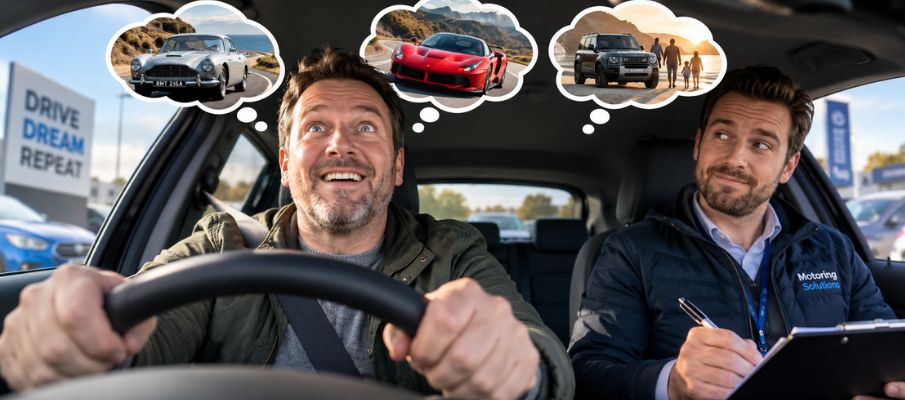
When people dream about cars they’ve never driven, they’re usually dreaming about a lifestyle, a personality, or a version of themselves. The car is simply the physical prop.
Pop Culture Did Most Of The Heavy Lifting
Hollywood deserves enormous credit for creating countless automotive obsessions.
Consider the DeLorean from the film Back to the Future. Before that film, it was a commercial disappointment. After the film, it became one of the most recognisable cars on the planet. Nothing about the driving experience created that love affair. Marty McFly did.
The same applies to the MINI from The Italian Job, the Aston Martin DB5 from James Bond, the Dodge Charger from Fast & Furious, and the Batmobile in virtually every incarnation.
People often confuse emotional attachment with automotive appreciation. In reality, they are usually falling in love with a story. The vehicle simply happens to be the star.
It’s no different from hearing an old Oasis song and instantly remembering a specific summer. The music becomes attached to the memory. Cars work exactly the same way.
Nostalgia Is The Most Powerful Engine Ever Built
Manufacturers spend billions developing engines. None of them are as powerful as nostalgia. Ask someone why they adore a particular car and you’ll often discover the answer has nothing to do with performance.
“My dad had one.”
“I saw one when I was eight.”
“It was in my favourite film.”
“It was on the cover of a magazine I bought every month.”
That emotional connection can survive decades. People still obsess over cars from their childhood even when objectively better alternatives exist today. A modern hot hatch might outperform a 1990s Japanese sports car in almost every measurable way.
Good luck convincing enthusiasts. Nostalgia doesn’t care about facts. Nostalgia doesn’t care about statistics. Nostalgia would happily choose an old cassette tape over Spotify and insist the sound quality is better.
Social Media Has Made The Problem Worse
Or better, depending on your perspective.
Twenty years ago, you had to physically see a dream car. Now you can watch it drift around a mountain road in 4K resolution while a cinematic soundtrack plays in the background.
Social media doesn’t sell cars. It sells fantasies. Instagram, TikTok, and YouTube have become giant automotive dream factories.
Every supercar appears to be driven through Monaco at sunset. Every performance SUV is filmed climbing a mountain. Every electric vehicle launches like a fighter jet. Nobody films themselves sitting in motorway traffic wondering why they spent £90,000 on something currently moving at seven miles per hour.
Reality rarely trends. Fantasy always does. As a result, people become emotionally invested in vehicles they’ve only ever experienced through perfectly edited content.
They’re not falling in love with the car. They’re falling in love with the movie trailer.
Scarcity Creates Desire
Human beings are remarkably predictable. Tell somebody they can’t have something and they instantly want it more. This explains why limited-edition cars become objects of obsession. The rarer the vehicle, the greater the mythology.
Ferrari understood this decades ago. Manufacturers know exclusivity creates status. Status creates demand. Demand creates desire. It’s the automotive equivalent of a sold-out concert. Suddenly everybody wants a ticket. Even if they didn’t know the songs.
We Secretly Love The Idea Of Reinvention
Here’s the controversial bit. Many people don’t actually want the car. They want the person they imagine they’ll become after buying it.
The rugged off-road SUV owner imagines weekend adventures. The sports car enthusiast imagines winding roads and admiration from strangers. The luxury saloon buyer imagines effortless success. The electric vehicle owner imagines themselves as a forward-thinking pioneer.
Cars are identity machines. They allow people to project aspirations onto a physical object.
It’s the same reason people buy expensive gym memberships in January. They’re purchasing a future version of themselves. Whether that version ever arrives is another matter entirely.
Sometimes Reality Is A Massive Disappointment
This is where things become fascinating.
Many dream cars turn out to be underwhelming once people finally drive them. The mythical experience they’ve built in their heads can rarely compete with reality. Some supercars are uncomfortable. Some classics feel slow. Some highly praised performance cars feel surprisingly ordinary.
Yet this rarely damages their reputation. Why?
Because people are attached to the story, not the experience. The legend survives even when reality doesn’t quite live up to expectations. That’s a powerful thing.
The Best Cars Live In Our Imagination
Perhaps that’s the real answer. The greatest car you’ve never driven can remain perfect forever. It never breaks down. It never needs servicing. It never develops rattles. It never disappoints.
The version in your imagination is always cleaner, faster, louder, and more exciting than the real thing. Reality introduces flaws. Fantasy does not. That’s why people can spend decades obsessing over a dream car without ever owning one. And perhaps that’s perfectly fine. Because cars have never been purely about transportation. They’re rolling symbols of freedom, ambition, nostalgia, status, rebellion, and identity. They are stories on wheels.
And sometimes the stories are far more powerful than the drive itself.
So the next time somebody passionately tells you their dream car is the greatest machine ever created despite never having driven it, don’t laugh. You’re probably doing exactly the same thing. You just happen to have a different poster on your wall.

Rob is an experienced automotive journalist and editor, with a passion for all things automotive. Whether it’s automotive news and reviews, the latest in EV technology, or just an unusual take on the latest models, Rob is all over it!