Let’s start with an uncomfortable truth: many expensive cars don’t actually feel expensive. There. I said it.
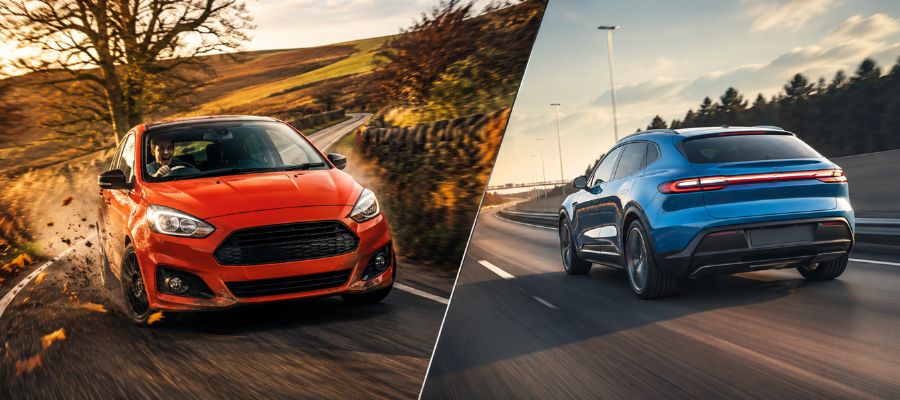
We’ve all experienced it. You climb into a six-figure luxury SUV expecting to feel like royalty, only to discover scratchy plastics hiding beneath the dashboard and enough fingerprint-covered piano black trim to make a forensic scientist weep. Meanwhile, somewhere on a used forecourt sits a humble hatchback costing less than a family holiday to Benidorm that somehow feels like you’ve accidentally wandered aboard a private jet.
So what gives?
Why can a £15,000 used car feel more premium than one costing four times as much? Why do some vehicles radiate wealth while others feel like somebody has wrapped a budget airline seat in leather and called it luxury?
The answer lies in psychology, clever design, and a few automotive magic tricks.
The Weight of Things Matters More Than You Think
Ever noticed how a car door can completely alter your opinion of a vehicle? It’s absurd, really. You can spend hours researching power outputs, fuel economy and safety ratings, but the moment you shut the driver’s door, your brain has already decided whether the car feels expensive.
Manufacturers know this. That reassuring “thunk” as the door closes is no accident. Engineers spend ridiculous amounts of time tuning sounds and adding insulation to create precisely the right sensation. It’s essentially automotive ASMR.
Think about the vault-like door shut on older German saloons. People still rave about them decades later. The sound is somewhere between a bank safe closing and the opening notes of a Hans Zimmer soundtrack. Meanwhile, a tinny metallic clang instantly transports you back to the sort of supermini your parents drove in 1998 while listening to Now That’s What I Call Music 41.
Heavy switchgear works in exactly the same way. A satisfyingly damped indicator stalk or a solid-feeling rotary dial subconsciously tells us that money has been spent. It’s why cheap plastic buttons can ruin an otherwise lovely interior. You could fit seats upholstered in unicorn hide, but if the climate controls feel like they’re borrowed from a children’s toy, the illusion disappears immediately.
Ambient Lighting: The Biggest Con Since Reality TV
Let’s talk about ambient lighting.
Modern car manufacturers have discovered that if you add enough LED strips inside a vehicle, buyers will apparently forget that half the dashboard is made from recycled yoghurt pots.
It’s brilliant. Twenty years ago, luxury meant wood veneers and handcrafted leather. Today, it apparently means your dashboard can glow purple.
Yet somehow, it works.
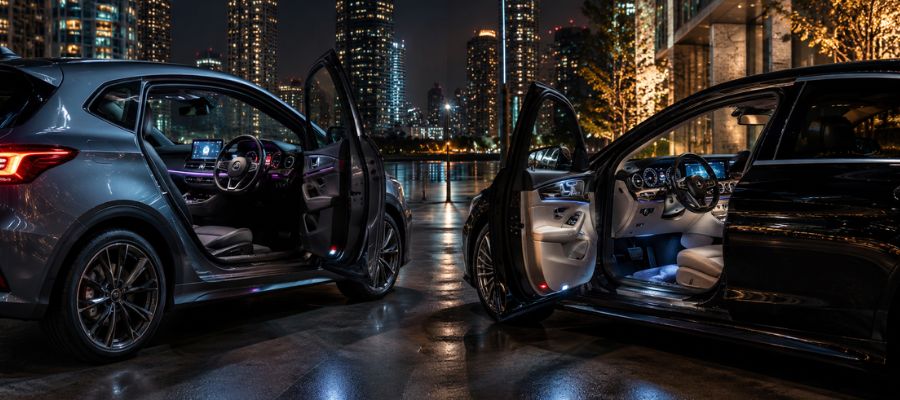
Drive a car at night with subtle ambient lighting and suddenly everything feels considerably more sophisticated. The cabin transforms from “commuter hatchback” to “exclusive members’ club in Mayfair”. Mercedes-Benz arguably perfected this trick. Their interiors at night resemble a cross between a nightclub, the bridge of the USS Enterprise, and a particularly enthusiastic gaming PC setup.
Purists hate it. Customers absolutely adore it. And frankly, if coloured LEDs convince someone they’re driving something special, who are we to judge?
Screens Make People Feel Rich
Here’s another controversial opinion. Large screens make cars feel expensive, even when they probably shouldn’t.
A giant infotainment display instantly suggests modernity, sophistication and technological prowess. It’s the automotive equivalent of owning the latest smartphone. This isn’t entirely rational. A screen costs manufacturers far less than intricate switchgear, premium materials or painstaking craftsmanship. Yet buyers often perceive giant displays as a sign of luxury.
Tesla proved this beyond doubt. The minimalist interior of the Tesla Model 3 was initially criticised for being sparse. Others saw it as futuristic, clean and cutting-edge. Suddenly, traditional dashboards packed with physical buttons began looking as outdated as Blockbuster Video.
Whether that’s progress or not remains hotly debated. Personally, there comes a point where dashboards start resembling the flight deck of the Death Star. Not every function requires a touchscreen buried three menus deep. And nobody should need software updates simply to adjust the heated seats.
Soft Materials Fool Us Every Time
Touch matters. A lot.
Humans are surprisingly primitive creatures. If something feels soft, we instinctively associate it with quality. Manufacturers exploit this shamelessly. You’ll often discover that only the surfaces drivers regularly touch are covered in soft materials. The upper dashboard, steering wheel and armrests feel lovely, while hidden areas remain gloriously cheap.
Go on. Open the glovebox in almost any vehicle. It’s frequently where dreams go to die. Nevertheless, strategically placed soft-touch materials work wonders. Combined with stitched surfaces, contrasting colours and tasteful textures, they can elevate even relatively affordable cars.
This explains why certain brands consistently punch above their weight. They understand where customers look, where they touch and, crucially, where they don’t.
Sneaky? Absolutely. Effective? Without question.
Silence Equals Sophistication
Want a car to feel expensive? Make it quiet. Noise, vibration and harshness are among the biggest differentiators between mainstream and luxury vehicles. The absence of noise creates calm. Calm creates comfort. Comfort creates the impression of quality.
It’s why electric vehicles often feel more premium than their price tags suggest. Remove engine noise and suddenly even an everyday family crossover can feel remarkably refined.
A quiet cabin allows conversations without shouting. Music sounds better. Journeys feel less stressful. Road noise, on the other hand, destroys luxury faster than almost anything else. No amount of leather can disguise wheel arches that sound like a snare drum every time it rains.
Brand Prestige Is Mostly In Our Heads
Time for (yet) another uncomfortable truth. Badges matter. A lot.
Place two identical cars side by side. Give one a premium badge and most people will instantly assume it feels more luxurious. This phenomenon isn’t unique to cars. Wine experts have repeatedly shown that people rate identical wines differently based solely on price and packaging. Humans are wonderfully irrational. Automotive brands benefit from exactly the same psychology.
A prestigious badge carries decades of heritage, advertising and cultural associations. James Bond drove an Aston Martin. Batman drove a Lamborghini-inspired Batmobile. Succession billionaires don’t arrive in beige hatchbacks. These associations shape expectations long before we even sit inside.
However, prestige isn’t everything. Increasingly, buyers are discovering that many mainstream brands now offer genuinely impressive levels of comfort, technology and perceived quality. Sometimes, the smartest purchase isn’t the expensive one. It’s the car that feels expensive.
The Secret Ingredient? Attention to Detail
Ultimately, expensive-feeling cars succeed because somebody obsessed over details. The stitching alignment. The texture of a volume knob. The way air vents move. The consistency of panel gaps.
These tiny touches rarely appear on specification sheets, yet they define how a car feels. Luxury isn’t always about cost. Sometimes it’s simply about care. And that’s why an affordable car can occasionally feel genuinely special, while an expensive one can leave you wondering where all the money went.
Because feeling expensive isn’t about price. It’s about perception. And perception, as the automotive world has repeatedly proven, is one of the most powerful forces in motoring.

Rob is an experienced automotive journalist and editor, with a passion for all things automotive. Whether it’s automotive news and reviews, the latest in EV technology, or just an unusual take on the latest models, Rob is all over it!