Almost nobody buys the car they actually need. There. I said it.
If human beings were entirely rational creatures, Britain’s roads would be packed with modest hatchbacks, sensible estates and perhaps the occasional practical SUV for genuinely large families. The nation’s best-selling vehicle would probably be something gloriously unexciting. We’d all drive the automotive equivalent of beige wallpaper while discussing annual fuel economy figures at dinner parties.
Thankfully, humans are spectacularly irrational.
Instead, people routinely buy seven-seat SUVs to transport one child and a Labradoodle. They purchase sports cars despite spending 95% of their lives sitting stationary on the M25. They finance gigantic pickups despite never carrying anything heavier than a weekly Ocado order.
So why do we do it? Because cars stopped being mere transport decades ago.
Cars are rolling biographies.
We Buy Cars To Become Someone Else
Here’s an uncomfortable truth: people rarely buy cars for who they are. They buy them for who they want to be.
The bloke purchasing a rugged off-roader isn’t necessarily scaling mountains every weekend. He’s buying into an identity. He likes the idea that, at any moment, he could disappear into the Scottish Highlands and live entirely off freeze-dried meals and Bear Grylls-inspired optimism.
Will he? Absolutely not. He’ll probably use it to drive three miles to Tesco.
It’s the same reason millions bought guitars after watching documentaries about bands like Oasis or seeing Marty McFly shred his way through Back to the Future. Most never became rock stars. That was never really the point. The purchase represented possibility. Cars are no different.
The convertible owner imagines spontaneous coastal road trips. The hot hatch driver imagines themselves as an undercover racing driver. The luxury SUV buyer pictures a life filled with countryside retreats, artisan coffee and children named things like Monty.
Reality often looks suspiciously like the school run and a queue at the drive-thru.
Status Matters More Than We’d Like To Admit
People love claiming they “don’t care what others think”. Rubbish. Human civilisation is essentially one long competition to impress strangers.
Social media has only accelerated this. We live in an age where people photograph breakfast before eating it. Naturally, the car parked outside the house has become another status symbol.
Centuries ago, wealthy individuals demonstrated status with horses, carriages and grand estates. Today, it’s often premium SUVs, prestige badges and personalised registration plates. Nobody needs a luxury performance SUV with heated cupholders, massaging seats and enough power to launch a small satellite into orbit. But people don’t buy prestige brands solely for practicality. They buy how those brands make them feel.
Driving a premium car can provide confidence, pride and satisfaction. There’s nothing inherently wrong with that. Humans have always attached emotional value to possessions. Just don’t pretend your £80,000 SUV was purchased purely because “it had slightly more boot space”.
We all know what’s going on.
Fear Plays A Bigger Role Than Logic
Modern car buyers are terrified of making the wrong decision. As a result, many people overbuy.
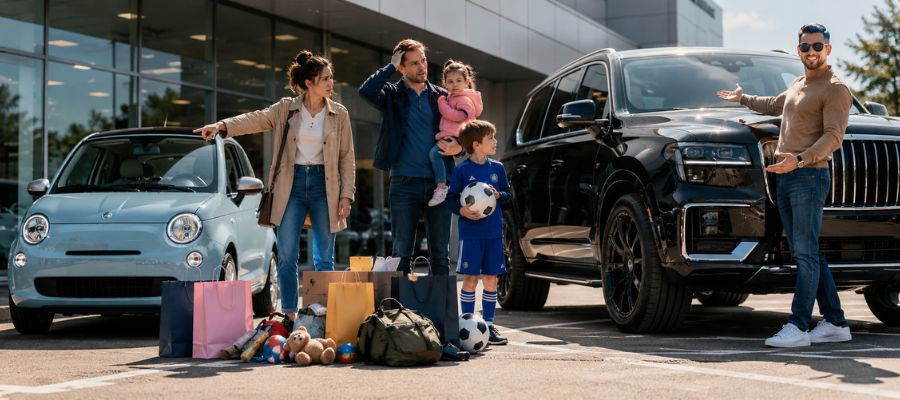
A family expecting one child suddenly convinces itself it requires a vehicle capable of transporting an entire junior football squad, three Saint Bernards, and enough luggage to survive a month-long Antarctic expedition.
Car buyers constantly ask themselves:
“What if we need more space?”
“What if we go camping?”
“What if relatives visit?”
“What if we have another child?”
“What if civilisation collapses?”
Suddenly, a perfectly adequate hatchback has been replaced by something resembling a small apartment block. The irony? Most cars spend their lives carrying one person. Research repeatedly shows average vehicle occupancy is remarkably low. Yet buyers continue preparing for highly unlikely scenarios. It’s automotive doomsday prepping.
The Influence Of Popular Culture Is Enormous
Popular culture has spent decades convincing us that certain cars equal success. James Bond didn’t drive a second-hand supermini. Batman wasn’t tearing around Gotham in a diesel estate. Even news and celebrity culture reinforce the message. Footballers arrive at training in high-end SUVs. Influencers pose beside exotic cars they’ve often borrowed for photographs. Films consistently associate powerful vehicles with success, freedom and desirability.
We’re not immune. No one watched Dominic Toretto in the The Fast and the Furious and thought:
“You know what? I’d quite like a sensible 1.2-litre hatchback with excellent visibility.”
Cars in entertainment are aspirational fantasies. Sometimes we buy the fantasy.
We Mistake Wants For Needs
Marketing departments deserve enormous credit. Or blame. Manufacturers have become astonishingly good at transforming luxuries into necessities.
Twenty years ago, heated steering wheels sounded ridiculous. Now people refuse to buy cars without them. Massaging seats? Panoramic roofs? Ambient lighting with 64 colour options? Wireless charging pads for devices we constantly forget to charge? None of these things are necessities. Yet once experienced, they become emotionally difficult to surrender.
Humans rapidly adapt to comfort. Psychologists call this hedonic adaptation. Everyone else calls it “I could never go back”.
That’s how wants quietly become needs.
The SUV Phenomenon Proves Everything
Nothing demonstrates irrational car buying quite like Britain’s obsession with SUVs. Some SUV owners absolutely need them. Large families, regular towing duties and challenging terrain make perfect sense. But let’s be honest. A significant proportion never leave tarmac. Many aren’t venturing off-road. They’re climbing kerbs outside primary schools.
Yet SUVs continue dominating sales because people enjoy sitting higher, feeling safer and projecting confidence.
Psychologically, bigger often feels better. It’s automotive comfort food.
Critics complain about oversized vehicles clogging narrow British roads, while owners insist they’ll never return to traditional hatchbacks. Both sides are probably correct.
The Car You Buy Says Something About You
Whether we like it or not, cars communicate. A classic sports car suggests enthusiasm. A battered old hatchback may imply practicality or indifference. An immaculate executive saloon might project professionalism.
None of these assumptions are entirely fair, yet humans make snap judgements constantly. Cars become extensions of identity. They’re part transportation, part personal branding exercise. That’s why buyers become emotionally attached. Nobody forms deep sentimental relationships with washing machines.
Cars accompany major life moments: first jobs, holidays, relationships, family milestones and road trips. They become memory machines.
So, Why Do People Buy Cars They Don’t Need?
Because people aren’t spreadsheets.
We’re emotional, contradictory creatures who dream bigger than our daily routines. We buy aspiration. We buy identity. We buy confidence. We buy possibility. Sometimes we buy status. And occasionally, we simply buy something because it makes us grin every time we walk back to it in a supermarket car park.
Need has never been the sole reason people choose cars. Thankfully. Because if logic always won, we’d all be driving identical grey hatchbacks. And frankly, that sounds unbearably dull.

Rob is an experienced automotive journalist and editor, with a passion for all things automotive. Whether it’s automotive news and reviews, the latest in EV technology, or just an unusual take on the latest models, Rob is all over it!