We’ve all done it. You arrive at a dealership determined to be sensible. You’ve prepared spreadsheets. You’ve watched seventeen YouTube reviews. You’ve compared boot capacities, fuel economy figures and depreciation forecasts. You’ve even promised your partner, your bank account and yourself that this time, you’ll be completely rational.
Thirty minutes later, you’re sitting in a bright red performance hatchback thinking, “You know what? Life is short.”
Somewhere between leaving the forecourt and negotiating the first roundabout, logic quietly leaves the vehicle. The truth is that test drives are among the strangest psychological experiences modern consumers willingly put themselves through. For an hour or so, perfectly reasonable adults transform into excitable teenagers, amateur racing drivers or deeply anxious overthinkers.
And car retailers know it.
The Test Drive Is Basically Speed Dating
Psychologists often compare car buying to dating, and frankly, they’re not wrong.
Think about it. You meet a complete stranger. You make instant judgements based largely on appearance. You spend a short amount of time together under slightly artificial conditions. Then you decide whether you’d like to commit thousands of pounds and potentially several years of your life to them.
It’s essentially Love Island with finance agreements.
Within seconds of opening the driver’s door, our brains begin forming emotional conclusions. Studies consistently show that humans make surprisingly quick first impressions, and cars are no different.
The seating position feels right? Positive. The door closes with a reassuring “thunk” rather than a cheap “clang”? Positive. The infotainment system doesn’t require a degree in astrophysics to operate? Very positive.
Before the engine has even started, many buyers have already subconsciously decided whether they like the car.
Manufacturers spend billions engineering these moments. That soft-touch dashboard wasn’t chosen by accident. Neither was the ambient lighting, the steering wheel thickness, or the carefully tuned sound of the indicator click.
Someone, somewhere, was paid handsomely to decide what your indicators should sound like.
We Don’t Buy Cars. We Buy Versions Of Ourselves
Here’s where things become slightly uncomfortable. Most people don’t actually buy the car they need. They buy the person they want to become.
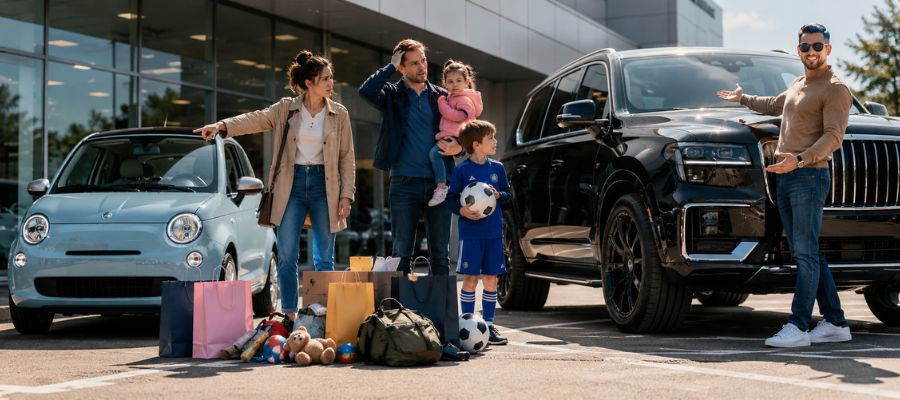
A family of four may only drive to school, Tesco and football practice, yet suddenly finds itself test-driving a huge SUV capable of crossing Mongolia during an ice storm.
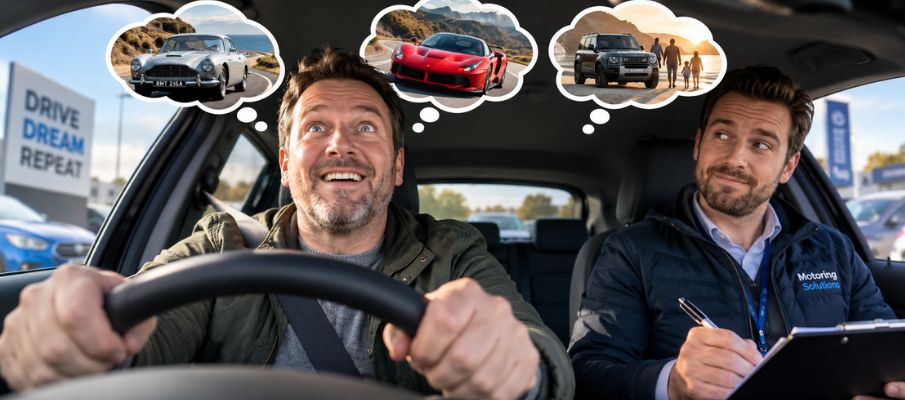
Why? Because that vehicle represents possibility. The sports car buyer isn’t purchasing horsepower. They’re buying youth, excitement and perhaps a lingering desire to be the lead character in their own action film. The rugged off-roader owner may never leave tarmac, yet enjoys knowing they could if civilisation collapsed tomorrow.
It’s the automotive equivalent of owning a guitar because you secretly believe you might one day become the next Jimi Hendrix. The reality is that many of us spend more time imagining future adventures than considering present needs. During a test drive, fantasy frequently beats practicality by a considerable margin.
The Salesperson Sitting Beside You Changes Everything
There is perhaps no stranger social interaction in everyday life than a test drive. You’re driving somebody else’s expensive property while a near-stranger sits beside you silently evaluating your behaviour.
It’s terrifying.
Suddenly, people who normally drive assertively become excessively cautious. Others do exactly the opposite and attempt to channel their inner Lewis Hamilton. Neither approach ends particularly well.
Researchers call this social facilitation: our behaviour changes when we’re being observed. You accelerate more gently. You indicate religiously. You avoid commenting on that cyclist who ignored three separate traffic laws. Some drivers even start apologising to the car.
“Sorry, little fella, bit of a rough gear change there.” The salesperson has heard all of this before.
Why Everyone Suddenly Wants More Power
One of the most bizarre phenomena in motoring is that almost every test drive convinces buyers they need more performance.
The prospective buyer arrives intending to purchase the sensible 1.5-litre version. Then they test-drive the higher-powered model. Disaster. Now the standard version feels slower than a mobility scooter towing a caravan uphill.
Psychologists call this anchoring. Once we’ve experienced something better, returning to the original option becomes emotionally difficult.
Streaming services understood this years ago. Give people a free month of premium entertainment and suddenly standard definition feels like watching television through a potato.
Car manufacturers know exactly what they’re doing. That punchy acceleration? Entirely deliberate.
Electric vehicles are particularly guilty. One enthusiastic burst of instant torque and buyers often emerge from the car laughing like they’ve just discovered fire.
The Confirmation Bias Problem
Many people begin a test drive having already made their decision. They simply don’t realise it.
If you’ve spent weeks watching reviews about a particular model, reading owner forums and imagining it parked outside your house, your brain starts seeking evidence that confirms your existing preference.
This is confirmation bias.
The suspension feels slightly firm? “Sporty.” Another car with identical ride quality? “Uncomfortable.” The infotainment crashes? “Probably just needs an update.”
Objectively, we’re hopeless. This explains why two people can drive the same vehicle and reach completely different conclusions. The truth is that test drives rarely change minds. They usually validate feelings that already exist.
The Weirdly Emotional Goodbye
Have you ever returned from a test drive and felt strangely sad handing back the keys? You’re not alone.
Even after twenty minutes, humans can develop emotional attachment surprisingly quickly. You’ve adjusted the mirrors. Connected your phone. Chosen your radio station. Perhaps imagined family holidays or daily commutes. For a brief period, the vehicle has already become part of your story.
Handing it back can feel oddly personal. It’s rather like finishing a brilliant Netflix series. Rationally, you know the characters aren’t real, yet somehow you still miss them. Cars occupy a similar emotional space. They’re not merely transport. They’re mobile stages upon which significant moments in our lives unfold. First dates. Family holidays. Late-night drives. New jobs. Break-ups. Big conversations.
No wonder we become attached.
So, Can You Ever Truly Be Rational?
Probably not. And perhaps that’s okay. Cars have never been purely logical purchases. If they were, we’d all drive identical beige hatchbacks with washable interiors and exceptional fuel economy.
Motoring would be efficient. It would also be unbearably dull.
The strange psychology behind test drives reminds us that humans are emotional creatures pretending to be rational. We buy with our hearts, justify with our heads, and occasionally convince ourselves that yes, we absolutely do need 350 horsepower for the school run.
So, the next time you head out on a test drive, remember this: the car isn’t just being tested. You are too.

Rob is an experienced automotive journalist and editor, with a passion for all things automotive. Whether it’s automotive news and reviews, the latest in EV technology, or just an unusual take on the latest models, Rob is all over it!