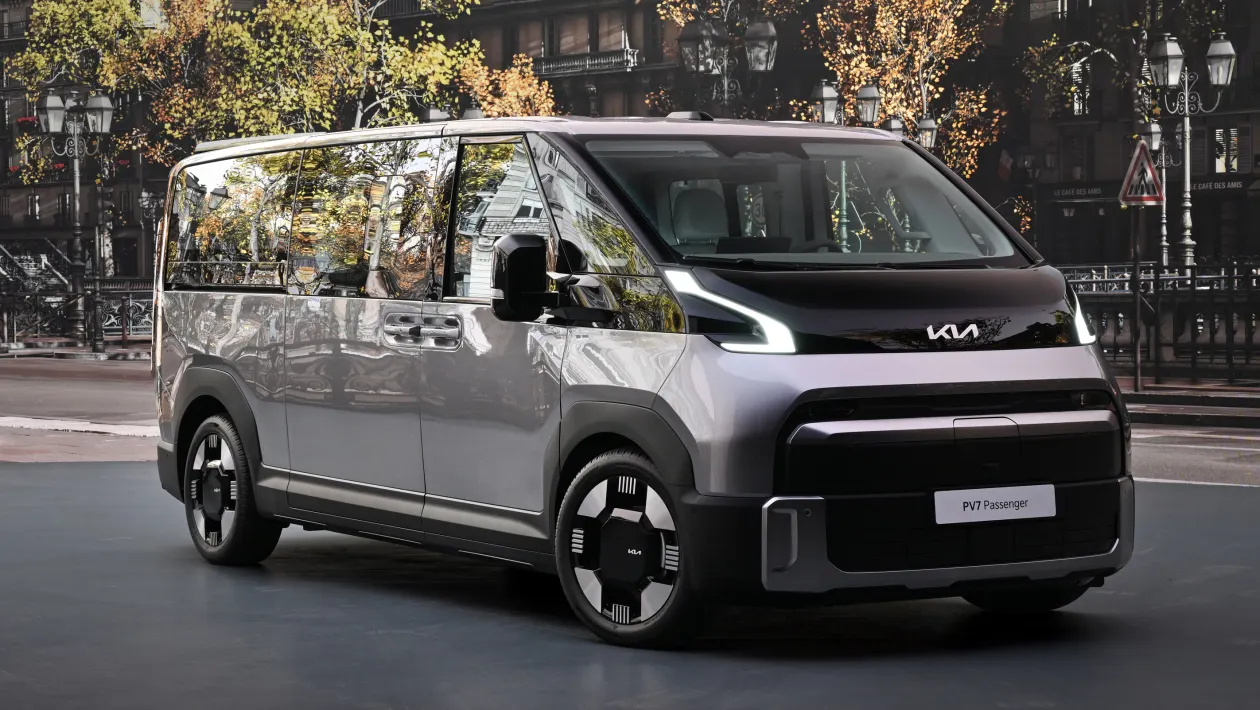
Electric vans often arrive wrapped in the language of disruption, then reveal themselves to be familiar boxes with a battery and a touchscreen the size of a chopping board. The Kia PV7 is more interesting because its cleverest ideas are gloriously practical. It has a low loading floor, tough corners that can be replaced after an argument with a bollard, and proper buttons for the functions drivers use all day. Somebody at Kia has clearly met a van driver.
Revealed at IAA Transportation in Hannover, the PV7 is the larger sibling to Kia’s PV5. It will arrive in Europe during the second half of 2027 in passenger and cargo forms, with more versions planned later. Its job is broad: carry nine people, swallow pallets, power tools and avoid turning a charging stop into an extended lunch break.
Nine seats without the minibus misery
The passenger version offers as many as nine seats globally, arranged across three rows. More significant than the headline number is Kia’s focus on getting people aboard without a minor expedition. A 399mm cabin step and a high roof are meant to make entry easier, while grab handles are positioned where hands naturally reach. That sounds mundane until you have watched a child, an older relative or a heavily laden passenger clamber into a tall vehicle designed primarily around its exterior dimensions.
Kia also plans several seating layouts, including seven- and eight-seat versions, with second-row options that can slide, fold or turn to face the rear. The result should be less like a fixed airport shuttle and more like a room that happens to travel. Vans have always been good at creating space; the PV7 appears determined to make that space pleasant rather than merely available.
The cargo version speaks fluent graft
For working life, the long-wheelbase cargo model offers 6.1 cubic metres of load space and is designed to take three Euro pallets. A high-roof derivative expands that to 8.0 cubic metres, while claimed payload reaches 1,165kg in the long version and 1,200kg in the compact model. The loading height is just 550mm, which matters far more at the end of a delivery round than another animated menu buried in the infotainment system.
Then there are the replaceable bumper corners and side cladding. They are small details with a big whiff of common sense. Commercial vehicles collect scars because they work for a living, and repairing a sacrificial corner is preferable to treating a scraped bumper as a full-body financial crisis. Kia says the PV7 family will eventually grow to 23 variants, so this is being designed as a working range rather than a single van wearing several hats for the brochure.
Charging speed aimed at the working day
The technical foundation is Kia’s dedicated E-GMP.S platform, with 71.5kWh and 96.2kWh nickel-manganese-cobalt battery choices. The front motor produces up to 200kW and 420Nm, and all-wheel drive is due later. Kia is targeting more than 460km of WLTP range for the long-range cargo model, although that remains an internal estimate until homologation. Call it roughly 286 miles, with the sensible caveat that payload, weather and motorway pace will all have their say.
An 800-volt electrical system is the more persuasive part of the pitch. Kia says a 10–80 per cent charge should take somewhere in the mid-20-minute range when using a 350kW rapid charger. That wording is deliberate: the charger rating is not the same thing as a confirmed peak intake for the van. Dual charging ports should make awkward bays less awkward, while vehicle-to-load capability can run equipment inside or outside the vehicle. For trades, mobile businesses and campers, that could turn the battery from dead weight between journeys into a genuinely useful power source.
A van with its head screwed on
At 5,350mm long and almost two metres wide before mirrors and handles, the PV7 is no shrinking violet. Yet its appeal lies in how little it seems to care about theatre. The dashboard keeps physical controls for regular jobs. The cargo floor is low. Body parts exposed to abuse can be swapped. The charging hardware is designed to reduce downtime. These are decisions shaped by repetition: the hundredth entry, the last parcel and the inevitable car-park scrape.
The PV7 will still have to prove its range with a real load, its comfort after a long shift and its price against established rivals. On paper, though, Kia has done something refreshingly unfashionable: it has treated practicality as a source of character. The result looks less like an electric lifestyle accessory and more like a useful machine with a sense of purpose. That is exactly what a big electric van ought to be.
Sources
- Auto Express: Kia PV7 discovery report
- Hyundai Motor Group: Kia PV7 world premiere announcement
- Kia Global: terms and conditions

We are experienced automotive journalists and editors, with a passion for all things automotive. Whether it’s automotive news and reviews, the latest in EV technology, or just an unusual take on the latest models, we’re all over it!