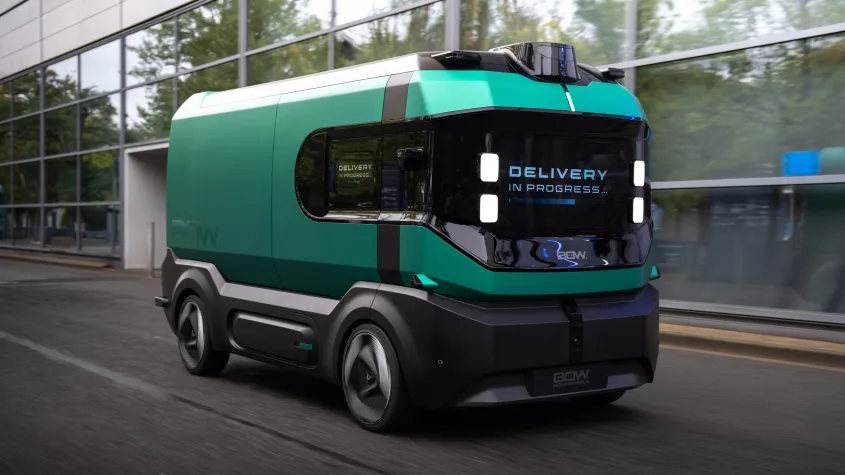
Vans have spent a century growing more comfortable for the person behind the wheel. Stellantis has now skipped to the obvious conclusion: get rid of the person altogether. Its BOW concept — short for Box-on-Wheels — is an electric delivery vehicle with no cab, no steering wheel and no need to pretend that a windscreen is cargo space.
That makes it look brutally logical. A conventional van devotes a large chunk of its footprint to a driver who occupies the vehicle for only part of its working day. BOW turns the entire object into a moving parcel. It is not elegant in the traditional sense, but neither is a filing cabinet, and both become rather attractive when you urgently need somewhere to put things.
The clever idea is the missing bit
Stellantis Pro One has developed the proof of concept with UQI Robotics, a Chinese specialist in autonomous systems, software and perception technology. The vehicle made its public debut at IAA Transportation in Hannover on 14 September, with the project initially aimed at European validation. This is not a new Vauxhall Vivaro quietly waiting for a price list. It is a rolling experiment in what happens when the delivery vehicle becomes part of the logistics system rather than merely its transport.
That distinction matters. A driverless box is only useful if it knows where to go, fits into a fleet operator’s software and can be loaded, charged, monitored and rescued when life inevitably becomes untidy. Stellantis says its role will include services, connectivity, fleet integration and business support. The less glamorous those words sound, the more important they probably are. Robot vans will succeed through boring competence, not science-fiction swagger.
UQI brings more than a clever demo
UQI is not being recruited simply to bolt a camera onto the roof. The company was established in 2020 as a joint venture between UBTECH and Miracle Automation, and Stellantis says it has deployed more than 7,000 robots across 66 cities and regions. Its work already spans mobile industrial robots, autonomous logistics vehicles and warehouse systems.
That experience gives BOW a better foundation than the average motor-show fantasy. An autonomous vehicle operating inside a planned logistics network is a more convincing proposition than one asked to improvise through every possible road, pedestrian and weather condition from day one. Start with repeatable jobs, prove the machinery and widen the envelope. Sensible engineering rarely makes for a dramatic film trailer, but it tends to survive contact with reality.
The unanswered questions are enormous
For all the confidence of the reveal, Stellantis has not published the figures that decide whether BOW earns its keep. There is no confirmed payload, cargo volume, battery capacity, driving range, charging time, production date or price. We also do not know how loading works in a normal depot, how remote supervision is handled or what happens when the machine meets a blocked kerb and one magnificently abandoned wheelie bin.
Those omissions are acceptable for a proof of concept, but they keep the champagne firmly corked. Delivery operators buy uptime and cost per job, not futuristic silhouettes. Removing a driver may free cabin space and reshape operating costs, yet autonomy adds sensors, computing, validation, connectivity and an entirely new category of things that can go wrong. The spreadsheet will be the real road test.
More than a vehicle — possibly too much more
BOW sits inside a wider Stellantis Pro One plan to stop behaving solely like a van manufacturer. The company wants 11 new commercial models globally by 2030 and is building services around data, charging, finance, vehicle conversions and proactive maintenance. Its stated ambition is to work towards 100 per cent vehicle uptime. That is corporate-language catnip, of course, but it reveals the scale of the bet: sell the operation as well as the metal.
There is a risk in trying to own every link in the chain. Fleet customers may appreciate one accountable supplier, or they may dislike becoming tied to a single ecosystem. A van can be repaired, sold or replaced; a deeply integrated software-and-service arrangement is stickier. BOW therefore asks a commercial question as much as a technical one: who controls the delivery business once the driver disappears?
A box worth watching
The concept is easy to mock because it looks exactly like its name, but that honesty is its charm. No fake grille. No lifestyle cosplay. No leather-trimmed cab for a robot that does not own trousers. It is a battery, a cargo hold and an autonomous brain arranged around one job.
Whether it becomes useful transport depends on the details Stellantis has yet to reveal. For now, BOW is neither revolution nor vapourware; it is a serious question on wheels. If it can move goods reliably, cheaply and without creating fresh chaos at the kerb, its blunt shape may become a familiar part of city life. If it cannot, at least the name will make the storage instructions wonderfully simple.
Sources
- Auto Express: Stellantis BOW discovery report
- Stellantis Media: BOW and UQI Robotics collaboration
- Stellantis Media: Pro One strategy and BOW concept
- Stellantis Media: rights of use for press materials

We are experienced automotive journalists and editors, with a passion for all things automotive. Whether it’s automotive news and reviews, the latest in EV technology, or just an unusual take on the latest models, we’re all over it!