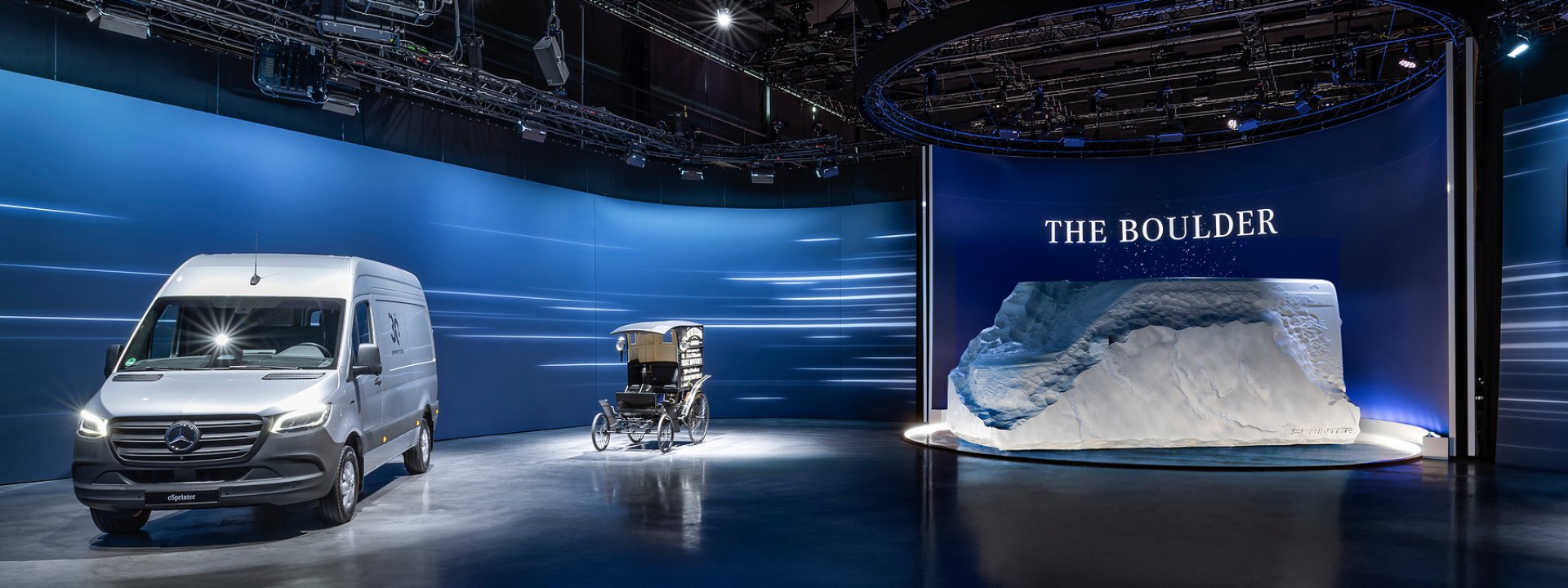
Camouflage is apparently too ordinary for Mercedes-Benz. To preview the next Sprinter, it has buried the van’s shape inside a vast stone-effect sculpture called THE BOuLDER. Subtle? About as subtle as parking a quarry in the reception area. Yet the theatrical lump may be an oddly honest way to introduce Britain’s most familiar working vehicle: there is a new van in there somewhere, but the useful details still require excavation.
The sculpture was first shown in October 2025 and measures 6.5 metres long, 2.75 metres high and 2.5 metres wide. Mercedes says it was milled from a solid workpiece, with sections removed to reveal the outline and selected design details of the future Sprinter. It looks less like a showroom model and more like a van trying to escape an especially severe car wash.
A design teaser that refuses to reveal the design
Car makers love teasing a headlamp, a badge or three millimetres of bumper. Mercedes has gone bigger while revealing remarkably little. The BOuLDER suggests a tall nose, a confident grille and the broad, upright stance expected of a large commercial van. Everything else dissolves into fake geology.
That is frustrating if you came for a clean look at the metal, but it also avoids pretending that styling is the Sprinter’s main event. Vans become ambulances, refrigerated boxes, mobile workshops, minibuses, campers and battered delivery heroes. Their bodies are drilled, extended, refrigerated and filled with shelving. A fashionable crease matters rather less than whether a converter can fit the right equipment without reaching for a swear jar.
Mercedes appears to understand this. The next Sprinter is being developed in numerous lengths, wheelbases and weight classes, with the company promising support for a wide range of factory and third-party conversions. That breadth is the real inheritance it has to protect. More than five million Sprinters have been produced since the name arrived in 1995, and Mercedes says 77 per cent of European customers buying in 2024 chose another one. When your repeat business is that strong, reinvention needs a steady hand as well as a sculptor.
Electric and combustion versions share the future
The new van family will split across two related architectures. Electric commercial models will use VAN.EA, while combustion-powered versions will sit on VAN.CA. That may offend anyone demanding one dramatic propulsion manifesto, but it is a practical decision for a vehicle sold into wildly different jobs and charging conditions. A city courier depot and a rural recovery operator do not face the same working day.
The electric side is the more intriguing engineering opportunity. A purpose-designed platform should give Mercedes more freedom over battery packaging, cabin space and conversion compatibility than adapting a combustion van. The official announcement does not provide the future Sprinter’s battery sizes, range, payload or launch date, so grand predictions can remain in the drawer beside the chisel. Those numbers will decide whether the new eSprinter becomes serious working kit or an expensive answer to a question only certain fleets can ask.
Software belongs in a van, if it earns its keep
Mercedes also plans to run the new generation on its MB.OS operating system, with over-the-air updates covering the complete vehicle software, including driver-assistance functions. Third-party apps will be able to appear through the vehicle interface, opening the door to fleet management and specialist navigation tools.
That sounds suspiciously like the usual software sermon until you consider a commercial vehicle’s life. Large-vehicle routing that keeps a tall van away from a low bridge is valuable. Earlier fault detection can save a day’s work. A fleet app that replaces a phone clamped awkwardly to the dashboard is progress. Animated menus and subscription confetti are not. Mercedes has the right ingredients; the challenge is making technology behave like a tool rather than another supervisor.
The BOuLDER is a silly object with a sensible message trapped inside it. The next Sprinter must serve more body types, two propulsion strategies and an increasingly digital working life without becoming fussy or fragile. Mercedes can chip away at the drama now. When the stone finally comes off, van buyers will want straight answers about payload, range, downtime and price. That is the reveal that counts.
Sources
- New Mercedes Sprinter is Boulder than ever before
- Mercedes-Benz Vans reinvents the transporter once again
- Mercedes-Benz Media terms of use
Image credit: Mercedes-Benz AG

We are experienced automotive journalists and editors, with a passion for all things automotive. Whether it’s automotive news and reviews, the latest in EV technology, or just an unusual take on the latest models, we’re all over it!