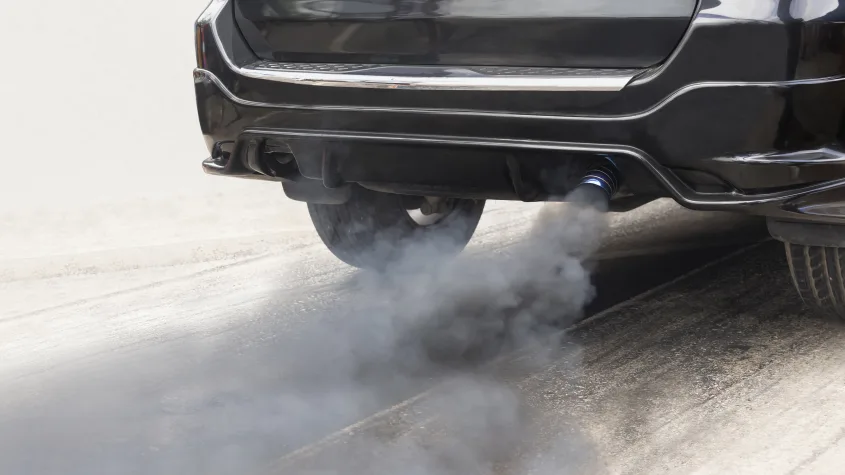
There are few more pointless sounds than an idling engine outside a school: a small mechanical grumble announcing that somebody would rather burn fuel than turn a key. Wales has now attached a larger price to that habit. Since 30 September, local authorities can impose fixed penalties of between £75 and £150 for stationary engine idling, replacing the old £20 charge.
The £150 headline will inevitably produce visions of council officers leaping from hedges whenever a rev counter twitches. The actual rules are less theatrical. This is aimed at drivers who leave an engine running unnecessarily on a public road and then fail to switch it off when asked by an authorised local-authority officer. It is not a fine for sitting in traffic, pausing at lights or dealing with an engine fault.
The expensive part starts with refusing
That distinction is the whole story. Stationary idling was already an offence; Wales has increased the fixed-penalty range because £20 had become about as intimidating as a sternly worded parking note. The enforcement power sits with local authorities, which can choose an amount within the new range. Their officer must first identify the offence and ask the driver to stop the engine. Compliance is therefore both wonderfully easy and completely free.
If you are parked and likely to remain there for more than a couple of minutes, switch off. Welsh Government guidance gives familiar examples of unacceptable idling: waiting to collect or drop off passengers, keeping the heater or air-conditioning running for comfort, charging a phone or listening to music. Being stationary because traffic is stationary is specifically recognised as an exception, as is running an engine for diagnostic or maintenance work.
In other words, nobody expects you to kill the engine every time Cardiff’s rush hour stops moving. The target is the driver sitting outside a school, shop, station or surgery with the exhaust quietly seasoning everybody else’s air.
A fine with a better purpose than revenue
The health argument is hard to dismiss. Exhaust pollution contributes to heart and lung disease, and children, older people and those with existing conditions are especially vulnerable. Idling concentrates that pollution precisely where people wait: at kerbs, entrances and pavements. One vehicle may feel trivial from behind a closed window. A queue of them at school-pick-up time becomes its own wheezing ecosystem.
The policy is also designed to make the money follow the problem. The amended regulations require authorities to use fixed-penalty income for enforcement and administration, air-quality improvements or measures that reduce exposure to transport emissions. That does not make a £150 notice enjoyable, but it is preferable to the cash simply vanishing into a council’s general biscuit fund.
There is a fair question about consistency. Allowing councils to select a figure between £75 and £150 reflects local circumstances, yet it also means the same stubborn refusal could cost different amounts in different parts of Wales. The Welsh Government’s own consultation found divided views on that flexibility, with concerns about confusion and a postcode lottery. Clear signs and a consistent first request will matter almost as much as the number printed on the notice.
Modern cars make the excuse look weaker
For many drivers, switching off requires no effort because stop-start already does it. For everyone else, the action remains simpler than finding another radio station. The old folklore that restarting automatically wastes more fuel than idling belongs with warming a modern car for ten minutes on the driveway: a habit that has outlived the machinery that inspired it.
Electric-car drivers can enjoy one rare moment of smugness, because an EV does not idle in the combustion sense. It can power heating, music and a phone without pumping exhaust at the pushchair behind it. That does not make every stationary EV virtuous, but it neatly exposes how unnecessary the pollution from a parked petrol or diesel car really is.
Enforcement will decide whether the new range changes behaviour or merely decorates a government webpage. Officers cannot be everywhere, and the worst idling hot spots tend to last for the chaotic few minutes when schools and stations empty. Education, visible patrols and a polite request will probably do more work than a pile of penalty forms.
Still, the principle is sound. Wales is not charging drivers for an unavoidable traffic jam; it is giving councils a sharper answer to an avoidable nuisance. When an authorised officer asks you to switch off, the clever response is not a debate about freedom, engine wear or how quickly your passenger will return. It is the button beside the steering wheel.
Sources
- Auto Express: £150 fine for leaving your car's engine idling in Wales
- Welsh Government: Fine for engine idling to more than triple
- Welsh Government guidance: Tackling stationary engine idling
- Welsh Government: Stationary vehicle engine idling consultation response
- The Road Traffic (Vehicle Emissions) (Fixed Penalty) (Wales) (Amendment) Regulations 2026

We are experienced automotive journalists and editors, with a passion for all things automotive. Whether it’s automotive news and reviews, the latest in EV technology, or just an unusual take on the latest models, we’re all over it!