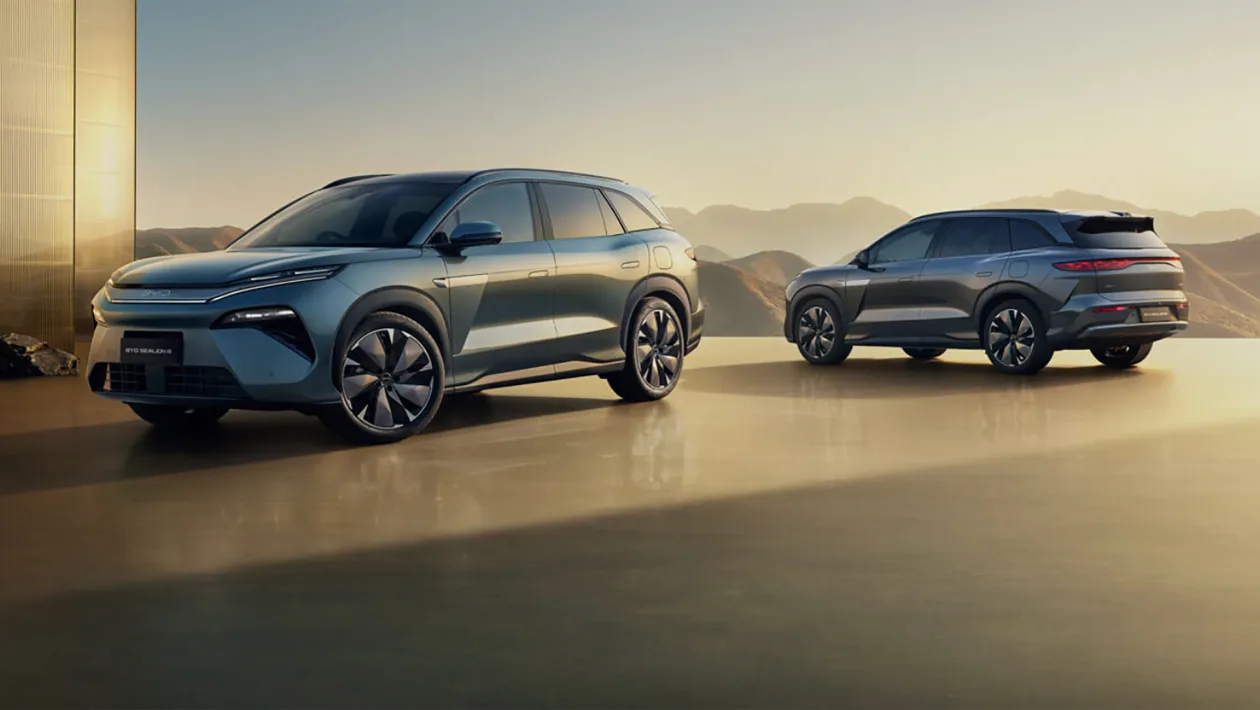
BYD has reached the stage where even BYD may need a wall chart to remember all the BYDs. The Sealion 8 is the latest arrival: a large, seven-seat plug-in hybrid now on sale in Australia, wearing the sort of confident specification sheet that makes a British launch feel entirely plausible. There is just one awkward detail. BYD already has a seven-seat plug-in hybrid heading our way.
That makes the Sealion 8 far more interesting than another entry in the great SUV multiplication table. It is quick, lavishly equipped and already built for a right-hand-drive market. Yet the car it must distinguish itself from is not merely a Kia, Hyundai or Skoda. It is the boxier BYD Ti 7 DM-p, which BYD’s UK site says is landing here this year.
A family bus with sports-car numbers
The Australian Sealion 8 comes in front- and all-wheel-drive forms, combining a 1.5-litre turbocharged petrol engine with BYD’s Dual-Mode 5.0 hybrid system. The livelier DM-p version produces 359kW and 675Nm, enough for a claimed 0-100km/h time of 4.9 seconds. That is faintly ridiculous for a vehicle designed to carry seven people and the associated mountain of coats, bottles and mysteriously sticky objects.
Ridiculous can be fun, of course. Effortless overtaking in a fully loaded family car has real value, and an electric motor’s immediate response suits a large SUV. But nobody has ever arrived late at soft play because their three-row hybrid lacked 359kW. If a UK version happens, price, electric range and genuine third-row comfort should matter more than winning an imaginary traffic-light contest.
BYD offers 19kWh and 35.6kWh versions of its second-generation Blade Battery in Australia. The headline electric-range figure is 152km for the DM-p, but that is measured on the more generous NEDC cycle. A future British car would need a WLTP figure before sensible comparisons can begin. Consider that Australian number a promising postcard, rather than a UK range promise.
The useful luxury is spread across all three rows
The cabin makes a better case for itself. Heated and ventilated front seats and three-zone climate control are standard in Australia, with air vents reaching every row. The range-topping version adds massage functions for the front seats and the two outer chairs in row two. There is also a 15.6-inch central screen, while luggage capacity reaches a quoted 1,960 litres with seats folded.
Some of that sounds like brochure confetti, but ventilation for the back and flexible seating are exactly the details that separate a proper family car from a fashionable SUV with two emergency stools in the boot. A 21-speaker stereo is amusing; keeping the third row cool during a summer motorway crawl is useful.
Britain already has a BYD seven-seater problem
The Sealion 8 does not currently appear in BYD’s UK model range, and the company has not confirmed it for this market. The Ti 7 does. BYD describes that incoming model as an urban box family SUV, also with plug-in hybrid power, a 15.6-inch screen and a flexible cabin. Put both in the same showroom without a sharp price and personality split, and customers may need name badges for the cars.
Perhaps that is the plan. The upright Ti 7 can play the rugged-looking, lifestyle-minded option, while the smoother Sealion 8 becomes the more conventional road-focused family flagship. That would be a credible pairing. It would also need BYD to explain the difference in one sentence, because ordinary buyers do not study model hierarchies for recreation.
The names are already doing little to help. Britain has the Sealion 5 and electric Sealion 7, alongside the Seal U, and BYD’s range is expanding with remarkable speed. Choice is welcome, but a showroom full of near-neighbouring numbers can make abundance feel like admin.
Bring it over — with a reason
The Sealion 8 deserves a British chance. Seven real seats, meaningful plug-in capacity and equipment aimed at every passenger form a strong recipe, while right-hand-drive Australian production removes one obvious obstacle. None of that confirms a UK launch, and it certainly does not settle the price.
If BYD does bring it here, the company must resist treating another model as an achievement by itself. Give the Sealion 8 a clear job, a credible WLTP range and enough daylight from the Ti 7 to make the choice obvious. The car already has plenty of power. What it needs now is a point.
Sources
- Auto Express: BYD Sealion 8 Australia launch and possible UK relevance
- BYD Australia: Sealion 8 official model information
- BYD UK: current model range
- BYD UK: Ti 7 DM-p official model page

We are experienced automotive journalists and editors, with a passion for all things automotive. Whether it’s automotive news and reviews, the latest in EV technology, or just an unusual take on the latest models, we’re all over it!