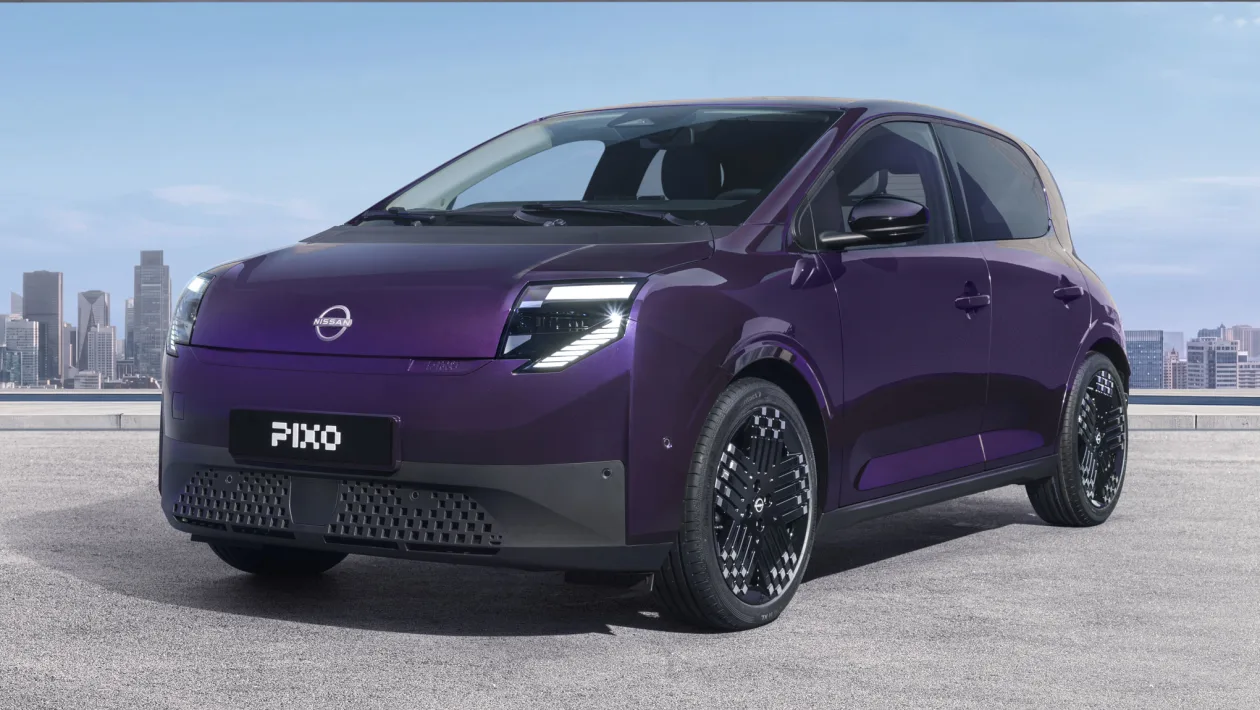
Small electric cars are routinely given an impossible job. They must be cheap, roomy, clever, desirable and capable of crossing a continent before the driver needs a sandwich. Nissan’s new Pixo takes a more useful approach: build a little car for little-car jobs, then resist stuffing it with half a tonne of battery to satisfy people who were going to buy an SUV anyway.
The result is a four-seat electric city car measuring just under 3.8 metres long, with a 27.5kWh battery and an official 161-mile WLTP range. Nissan will reveal prices and market specifications from December, with customer deliveries scheduled for early 2027. That missing price is the whole story, really. The Pixo’s engineering looks pleasingly disciplined; now the number on the windscreen must show the same restraint.
A small battery is the point
There will be grumbling about 161 miles, because range has become the electric-car equivalent of megapixels: the easiest number to compare and the least interesting once it is sufficient. For a car designed around towns, school runs and short commutes, 161 official miles is not an apology. It is an argument against carrying unused battery through every roundabout.
The lithium iron phosphate pack is the first of its type fitted to a Nissan model in Europe. Rapid charging peaks at a modest 50kW, but capacity matters as much as the headline rate. Nissan says a 15-to-80 per cent refill takes about 28 minutes, while 11kW AC charging is standard. That combination will not impress the motorway endurance crowd. It should suit the person who plugs in at home, at work or during a weekly supermarket visit.
This is what right-sizing looks like: enough range to make city life easy, without pretending every urban runabout needs to haul a battery designed for Aberdeen-to-Plymouth heroics.
The packaging is cleverer than the badge
The Pixo carries four adults, rather than squeezing in a fifth seatbelt for brochure bragging rights. Its two rear seats slide independently, allowing owners to trade legroom for luggage space. With both rear chairs in use, Nissan quotes a 356-litre boot, including 50 litres beneath the floor for charging cables. Fold them and the figure rises to 1,221 litres.
Those numbers are unusually grown-up for something shorter than many superminis. More valuable still is the ability to change the balance one passenger at a time. A city car often spends Monday carrying people and Saturday carrying flat-pack furniture, gardening compost or the consequences of an ambitious trip to the tip. Fixed packaging is cheap; flexible packaging is useful.
The 9.9-metre turning circle should matter every day, too. We have reached a peculiar point where cars marketed for cities can feel like canal boats in a multistorey. The Pixo at least appears to remember the environment it was designed to inhabit.
Perhaps the robot can calm down
Nissan has not been shy with the electronics. Google built-in, the Gemini assistant and Face ID are joined by a 10-inch touchscreen and seven-inch driver display. Adaptive cruise control, hands-free parking and one-pedal operation also feature in the announcement.
Some of that is welcome. Reliable route planning and pre-conditioning can make an EV easier to live with. Face recognition and a conversational assistant feel rather grand for a compact runabout, as though the corner shop has hired a maître d’. The test will be whether the technology removes effort or simply creates accounts, menus and software updates. A small car should reduce life’s admin.
Sharing a factory is common sense
Nissan designed the Pixo, while Renault will manufacture it at Novo Mesto in Slovenia. That partnership is not something to apologise for. Developing a dedicated small car is expensive, margins are thin and buyers still expect modern safety and connectivity. Sharing the industrial burden is exactly how affordable cars survive.
The styling details give Nissan room to establish its own character: pixel-like lights, bright colours and hidden “23” motifs referencing the Japanese pronunciation of Ni-San. It is playful without relying on fake toughness or enormous plastic wheelarches, which already puts it ahead of half the cars claiming to be urban adventurers.
December decides whether the idea works
The Pixo gets the difficult fundamentals right. It is genuinely compact, sensibly ranged, usefully packaged and built through a partnership that should keep development costs under control. What Nissan has not supplied is the figure that determines whether any of that discipline reaches the customer.
City cars cannot succeed on charm and charging curves alone. They need monthly payments and cash prices that make larger used cars look unnecessarily cumbersome. If Nissan prices the Pixo with the same clear-headed logic used to size its battery, it could be one of 2027’s smartest electric cars. If not, all that clever packaging will amount to a very efficient way of carrying fresh air around showrooms.
Sources

We are experienced automotive journalists and editors, with a passion for all things automotive. Whether it’s automotive news and reviews, the latest in EV technology, or just an unusual take on the latest models, we’re all over it!