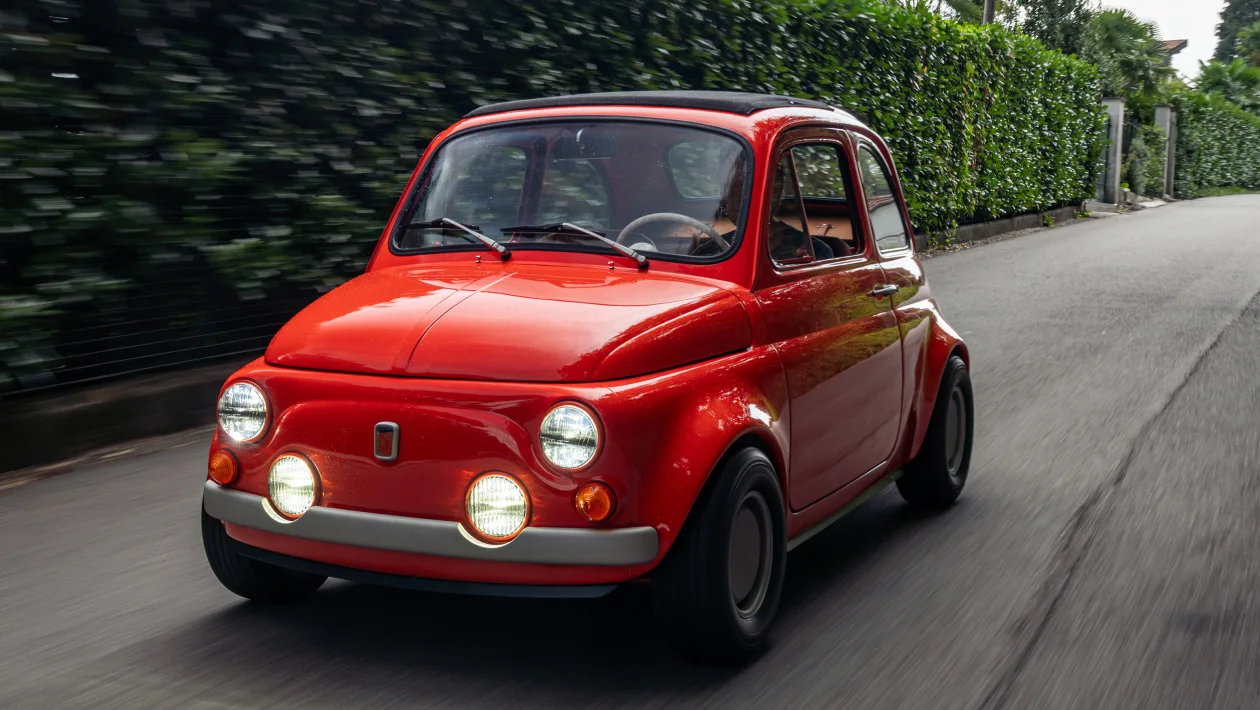
Restomods have developed a horsepower problem. Give a specialist an old car and, before long, it seems to acquire enough carbon fibre to qualify as sporting equipment and enough power to frighten the postcode. La Cinquecento’s Fiat 500 Scattante takes a more charming route: keep it tiny, keep the engine at the back and concentrate on making the whole thing feel alive.
That sounds obvious. It is also surprisingly rare. The original Fiat 500 became an icon by doing a great deal with very little, so turning one into a shrunken supercar would miss the joke. Scattante starts with a 1973 donor and rebuilds the engineering underneath while preserving the proportions and simplicity that made the little Fiat irresistible in the first place.
Small is the main event
The headline number is not power. La Cinquecento is targeting a weight of about 650kg, which is roughly the mass of a modern car’s collection of touchscreens, cupholders and emotional-support SUVs. The engine is a Fiat 126-derived unit of around 802cc, still mounted at the rear and working through a transaxle layout.
There is something deeply satisfying about that restraint. An 802cc engine will not win an internet argument conducted entirely in dyno graphs, but a light car does not need to arrive at every corner carrying the momentum of a garden centre. Modest mechanical ingredients can feel busy, eager and important when they are not buried beneath a tonne and a half of equipment.
The company says the engineering has been developed around response and balance. Those are sensible targets because the appeal of a classic 500 has never been a top-speed figure. It is the sensation of making progress in something narrow enough to leave spare road on both sides, with an engine that has to participate in the conversation.
A rebuild, rather than fancy upholstery
Scattante is described as being built from the ground up, with very little below the familiar body left in the 1970s. That distinction matters. The restomod label is now applied to everything from meticulous re-engineering to an old car wearing expensive leather and a Bluetooth stereo. La Cinquecento appears interested in the bones of the thing.
Keeping the original rear-engined character is the clever decision. It would be easy to chase fashion with batteries, enormous tyres or a powertrain borrowed from something twice the size. Instead, the 126-based engine develops the existing idea. The result should remain recognisably related to the car that inspired it, rather than becoming a modern machine trapped inside a novelty costume.
There is risk in this approach, too. The Fiat 500’s rough edges are part of its personality, and polishing every control until it feels contemporary could sterilise the experience. The best version of Scattante will improve precision without sanding away the cheek. A tiny Italian car should retain at least a trace of mischief; otherwise it is merely furniture with number plates.
The original earned its halo
Fiat launched the Nuova 500 in 1957 with a 479cc, 13hp two-cylinder engine and less than three metres of bodywork. Nearly 3.9 million were sold during the original production run, which ended in 1975. Those figures explain why the shape carries such weight despite occupying so little road.
It helped make personal mobility affordable, but it also proved that economy need not be joyless. That is the inheritance every reworked 500 must handle carefully. Add too much luxury and the car becomes a jewel box. Add too much speed and it becomes a punchline. The difficult, interesting task is to make it better without making it less itself.
A handful is enough to make the point
La Cinquecento plans only a handful of made-to-order cars each year. That almost certainly keeps Scattante in the realm of indulgence rather than everyday transport, and detailed pricing has not been published on the company’s site. Fair enough: hand-built nostalgia has never been the economical route to the shops.
Yet this little project makes a larger argument. A special car does not need four-figure power, active aerodynamics or a Nürburgring alibi. Sometimes it needs less: less mass, less width, less theatre and fewer excuses. If Scattante can preserve the Fiat’s grin while tightening everything beneath it, the restomod world may finally have found a power figure worth boasting about: 650kg.
Sources
- Auto Express: La Cinquecento Fiat 500 Scattante discovery report
- La Cinquecento: official Scattante information
- Fiat: official history of the original 500

We are experienced automotive journalists and editors, with a passion for all things automotive. Whether it’s automotive news and reviews, the latest in EV technology, or just an unusual take on the latest models, we’re all over it!