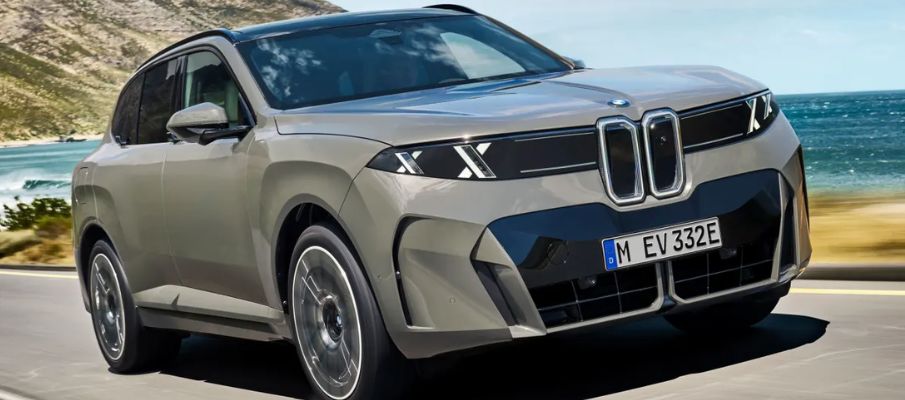
BMW has built one million full-fat M cars, and number 1,000,000 is gloriously unsubtle: an M3 Competition painted Fire Orange III. It looks like a highlighter pen with a mortgage. Yet the most important car in the celebration is the one lurking behind it in camouflage, because BMW has now confirmed that its first fully electric M3 will be made in Munich.
That is more than another factory allocation. The M3 is returning to the plant where its story began, while the plant itself is abandoning combustion. From 2027, BMW says Munich will build only electric vehicles. The next M3 will therefore carry forty years of expectation into a factory being remade around batteries, software and Neue Klasse hardware. No pressure, then.
A million cars, one awkward question
BMW M began as a small motorsport outfit in 1972. The original road-going M3 arrived in the mid-1980s as a racing homologation special, the sort of car created because the rulebook demanded it. Four decades later, the badge has spread across saloons, coupés, estates and SUVs, while Munich has just completed the millionth high-performance M vehicle.
Purists can argue about whether expansion diluted the recipe, but a million cars proves the appetite never disappeared. Buyers still want the mixture BMW describes as road and track ability with everyday practicality. The difficult bit is preserving that attraction when the straight-six, gearshifts and exhaust note are no longer doing the emotional heavy lifting.
BMW’s announcement wisely avoids trying to answer that question with a giant power figure. It confirms the electric M3, its Neue Klasse basis and its Munich production home. It does not announce output, battery capacity, range, price or acceleration. Good. An M3 has never mattered because it won a pub argument on a spreadsheet. The electric one must earn its badge through response, balance, stamina and the way it makes a driver take the long road home.
Munich is changing around the M3
The current-generation M3 has been built at BMW’s Munich plant since 2020, but the site’s connection with the model stretches back to the first generation. BMW says the electric successor will be produced there exclusively, alongside the new electric i3 as the second Neue Klasse model from the factory.
Preparing for that future has meant rebuilding roughly a third of a plant that has operated for more than a century. A new body shop, modern assembly areas and fresh logistics facilities form part of a €650 million investment. More impressively, BMW says the conversion happened while production continued. Renovating a factory without stopping the line sounds like changing the tyres while the car is still lapping.
That investment gives the announcement weight. Concept cars are easy; tooling a historic urban factory for exclusive production is a considerably more expensive promise. BMW has tied the electric M3 to its home city, its workforce and a site that will soon have nowhere to hide behind petrol alternatives.
Electric must mean more than faster
The temptation will be to make the new M3 brutally quick and declare the job finished. Electric motors can deliver devastating acceleration with almost vulgar ease. The harder work begins after the launch-control party: controlling mass, repeating performance as the battery heats, giving the steering believable texture and making the car adjustable without burying every decision inside a touchscreen.
BMW M knows the standard. Its chief, Franciscus van Meel, used the millionth car to repeat the division’s promise of racetrack capability and everyday usefulness. Those two halves pull in opposite directions even before a large battery joins the conversation. A track car wants lightness and cooling; a daily EV wants range, comfort and quiet efficiency. The successful electric M3 will make those compromises feel deliberate rather than negotiated.
There is also no need to erase the petrol M3 from memory. The Fire Orange milestone car is not an embarrassing ancestor parked outside the future. It is the reference point. BMW is effectively putting the two eras in the same photograph and asking its engineers to make the next one worthy of the previous 999,999.
The badge now has to do real work
An electric M3 was inevitable; confirming Munich is the meaningful part. The car will come from the same city and plant that helped turn M into a million-car phenomenon, but sentiment alone cannot tune a chassis. BMW has bought the machinery, rebuilt the factory and chosen its most scrutinised badge for the transition.
Now it must resist the easy spectacle of four-figure power and create an electric sports saloon with discipline. The millionth M car celebrates what BMW has achieved. The camouflaged one beside it will decide whether the next million still deserve the letter.
Sources
- Auto Express: electric BMW M3 and millionth M car report
- BMW Group: Plant Munich builds milestone BMW M3 and shapes BMW M’s electric future
- BMW M: The one-millionth BMW M vehicle

We are experienced automotive journalists and editors, with a passion for all things automotive. Whether it’s automotive news and reviews, the latest in EV technology, or just an unusual take on the latest models, we’re all over it!