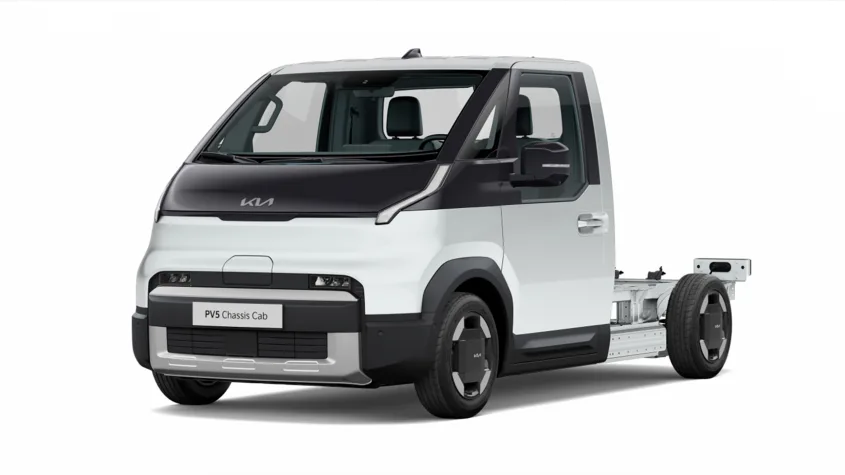
The new Kia PV5 Chassis Cab arrives looking as though somebody forgot to finish it. Good. That exposed frame behind the cab is not an omission but an invitation: add a tipper, a refrigerated box, a mobile workshop or whatever else earns its keep before breakfast.
Cars spend fortunes pretending to suit every lifestyle. This electric Kia takes the refreshingly honest route of admitting it does not know what job you do. It supplies the cab, battery and bones; a converter supplies the useful bit. In a market stuffed with lifestyle pick-ups that rarely meet anything grubbier than a garden-centre car park, that clarity is rather appealing.
A blank canvas with dirty boots
Kia built the PV5 Chassis Cab on its E-GMP.S commercial-vehicle platform, with an open rear section designed for specialist bodies. The company lists refrigerated boxes, tippers, mobile workshops, ambulances and service vans among the possibilities. A European high-box conversion can swallow as much as eight cubic metres, while the unfinished standard-range chassis is quoted at up to 1,005kg of payload.
Those figures matter, but the clever part is the attitude. The chassis cab is designed around conversion from the start rather than treated as a panel van that has endured an appointment with an angle grinder. Kia says it worked with European converters on the structure, giving body builders proper mounting points and a flat foundation. That should make the finished vehicle feel like one coherent tool rather than two products introduced over email.
For British operators, the attraction is obvious. A compact electric base could become a council tipper in the morning, a bakery van by lunchtime or the least intimidating ambulance in the fleet. The PV5 is under five metres long and Kia quotes an 11-metre kerb-to-kerb turning circle. That is the sort of detail that matters when your workplace is a loading bay designed during the reign of Queen Victoria.
The battery story still needs tidying
Here is where Kia’s message becomes less beautifully modular. Auto Express reports that UK Chassis Cab models will use the 71.2kWh Long Range battery and that conversions are planned later in 2026. Kia’s current UK product page, however, still highlights a 51.5kWh battery and warns that its figures remain provisional. Until the manufacturer publishes final UK prices, homologated range and conversion-specific payloads, the brochure remains a sketch rather than a buying tool.
Kia has at least shown what the larger pack can do elsewhere. Its Danish operation has launched the 71.2kWh version with a 120kW motor, a claimed 10-to-80 per cent charge in around 30 minutes and a six-and-a-half-hour 10-to-100 per cent AC charge at 11kW. Range depends heavily on the body attached to the back, so quoting the panel van’s 416km WLTP result as though it applies to a refrigerated brick would be optimistic bordering on decorative.
That variability is not a flaw unique to Kia; it is the entire physics lesson of a chassis cab. A low dropside, tall Luton box and freezer van will have different mass and aerodynamic appetites. Serious buyers need figures for the finished conversion, not an impressive number borrowed from the slipperiest relative at the family gathering.
Electric vans become convincing when they solve boring problems
The PV5 will not excite everyone. It has no heroic lap time, no drift mode and no launch-control graphic involving flames. It merely promises to carry tools, food, parcels or people through cities without a diesel clatter. That sounds mundane until you remember that mundane work is what keeps a country moving.
Kia is also bringing the right sort of confidence. The cab can provide vehicle-to-load power for equipment, while the platform’s compact footprint should help on depots and building sites. A seven-year vehicle warranty and separate eight-year battery cover add useful reassurance, although exact UK terms and conversion coverage deserve careful reading once the full offer is published.
The danger is price. A clever electric foundation can quickly become an expensive one after a specialist body, charging hardware and fleet software join the invoice. Kia must make the sums work for the plumber with three vans as well as the logistics giant ordering three hundred. If it does, the PV5 Chassis Cab could be more disruptive than another electric SUV with a panoramic roof.
There is something pleasingly grown-up about a vehicle whose most important feature is the empty space behind its occupants. The PV5 Chassis Cab does not arrive with a finished identity because work vehicles do not need one. They need potential, sensible dimensions and numbers that survive contact with a payload. Kia has supplied the first two. Final UK specifications and prices must prove the third.
Sources
- Auto Express: Kia PV5 Chassis Cab UK news
- Kia UK: PV5 Chassis Cab
- Kia Denmark: PV5 Chassis Cab Long Range announcement
- Kia Europe: PV5 Chassis Cab technical release

We are experienced automotive journalists and editors, with a passion for all things automotive. Whether it’s automotive news and reviews, the latest in EV technology, or just an unusual take on the latest models, we’re all over it!